Most senior care marketing problems get blamed on the ads.
A lot of them happen after the ads did their job.
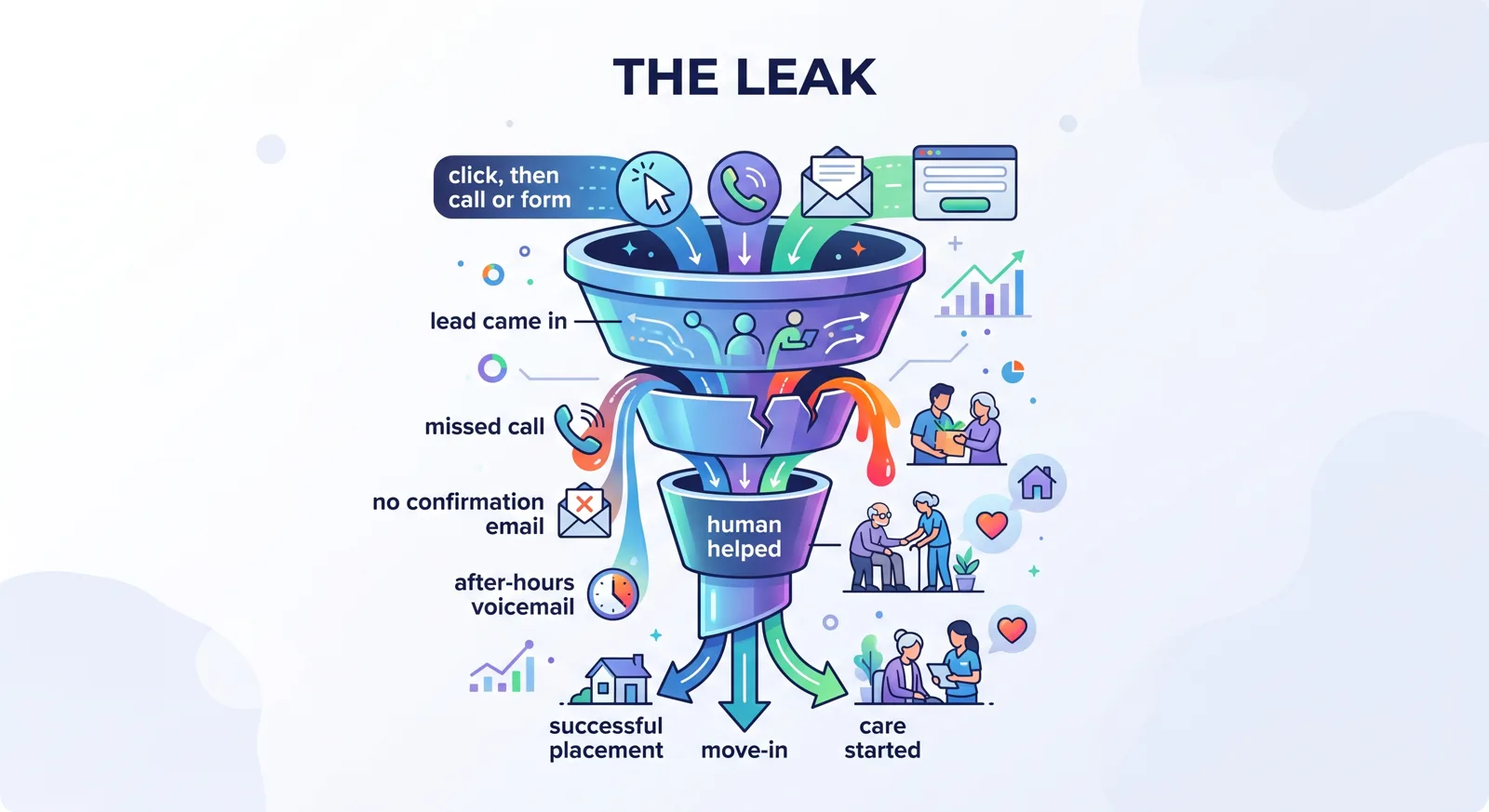
Someone clicked. Someone called or filled out a form. And then the lead quietly went somewhere else.
That gap, between "we got a lead" and "a human actually helped this family," is where a good chunk of ad spend disappears. It is part of the whole path from click to call. Here's how we think about closing it, and the checklist we walk clients through.
Start with how the lead wants to reach you
When we set up ads for a senior care client, one of the first questions isn't about keywords.
It's this: what's the best way for this person to contact you, and are you going to pick up?
For a lot of senior-serving businesses, the answer is the phone. Placement agencies are the clearest example.
A referral comes from a hospital or a skilled nursing facility. Someone needs a placement now. Not tomorrow. Now.
If you don't answer, they're not leaving a voicemail and waiting. They're already dialing the next name on the list.
So if phone is the call to action, the real question is whether someone will answer it. If the honest answer is "not always," that's fine. You just need a plan for the times nobody can.
Find out when families actually call
Most calls come in during the workday. That's when families are making calls and getting things done.
But don't sleep on weekends.
Weekends can be great for calls. And they're exactly when a lot of marketing and sales directors aren't in the building.
If the phone rings on a Saturday and nobody picks up, that family is calling the next name on their list.
Pull your call logs. Look at the days and the hours. You might be closed during one of your best windows.
Getting weekend and after-hours calls routed to a real person, instead of a voicemail box, is one of the simplest changes you can make.
A human still wins
We work with a lot of AI tools. We like them.
But here's a story a lawyer told us that we keep coming back to.
A family called two law firms about a case. At the first firm, they couldn't reach a lawyer, so they left their details.
So they called the second firm. A lawyer picked up right away.
The second firm got the case. It turned out to be a big one.
That's the whole lesson. People feel taken care of when another person says, "I hear you, and I'm going to help." In senior care, where nearly every call starts with a hard story, that matters even more.
Everything below is about making sure that human moment happens faster, or covering the gap when it can't.
The speed-to-lead checklist
1. Build a smart phone tree
Don't route every call to one person's desk.
If you have three people who can take an inquiry, put all three in the tree, so if one doesn't pick up, the next one rings. This is cheap and quick to set up with most modern phone systems.
2. Cover after hours with something better than voicemail
That might be an on-call person, an answering service, or an AI voice assistant that can collect details and get the family to someone. We build chatbots and voice assistants for exactly this gap.
If you go the AI route, have it say it's an AI right away and offer a person. Families in this space are already on guard, and honesty wins their trust fast. (We wrote more about whether your AI should say it's AI.)
3. Text back missed calls
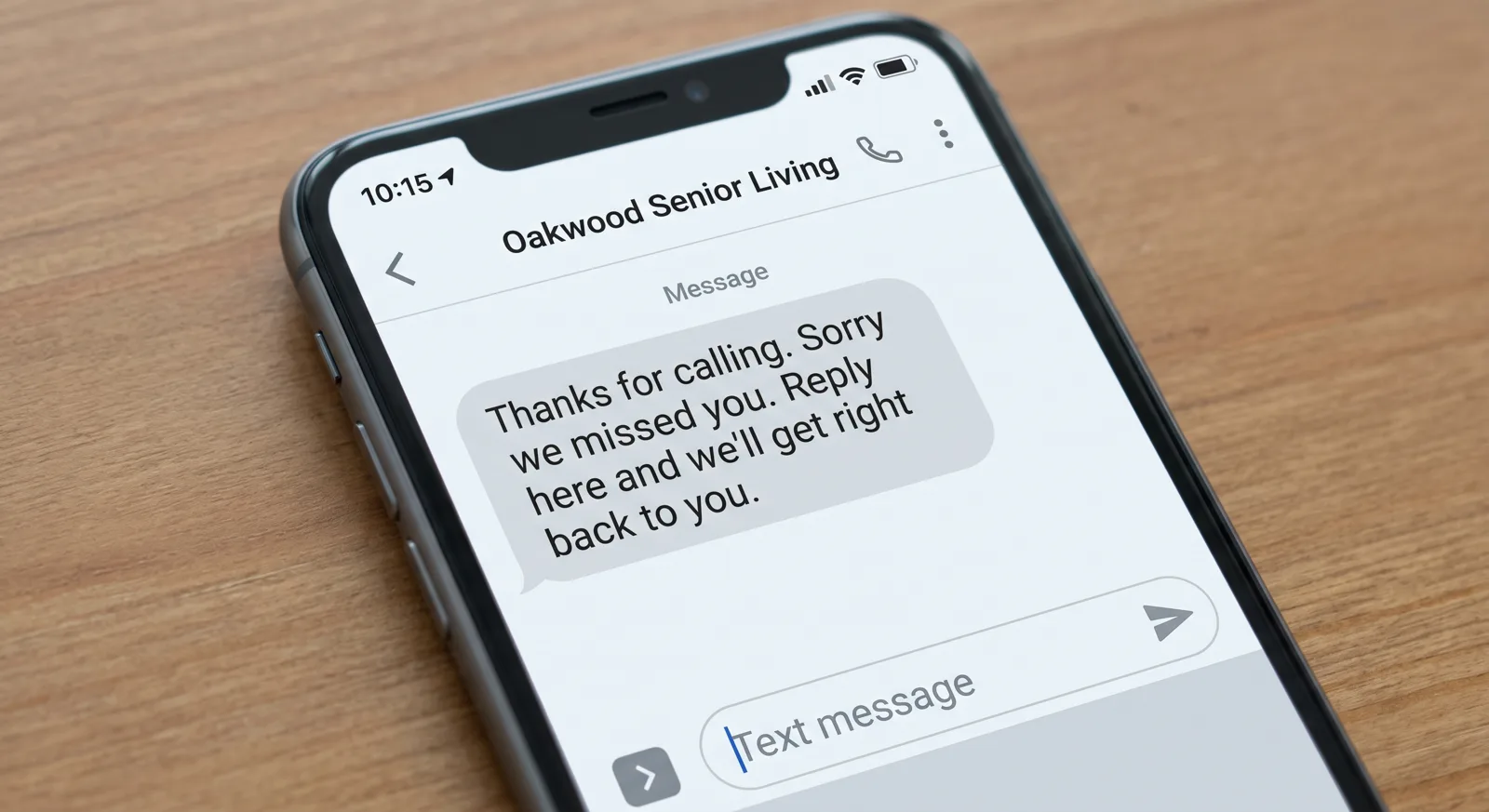
If someone calls and doesn't reach a human, send a quick text.
"Thanks for calling. Sorry we missed you. Reply here and we'll get right back to you."
That's it. Lots of people would rather text than talk anyway, and a fast text tells them they weren't ignored. Before you turn this on, check the texting consent rules with your phone provider.
4. Send a confirmation email from your own domain
When a family fills out a form, two emails should go out instantly.
One goes to your team: new lead, here are the details.
The other goes to the family: we got this, here's when you'll hear from us, and here's a little about what happens next.
That second email has to come from your domain. If your forms deliver leads through a generic system, the family usually gets nothing back. They're left wondering whether the form even worked, and they keep shopping.
A confirmation that lands in their inbox in seconds won't stop everyone from calling the next place. But it buys you time.
5. Text your salesperson, not just their inbox
Your marketing or sales director is probably not sitting at a computer all day. They're giving tours. They're in meetings.
So when a form comes in, send a text alert to their phone: "New inquiry from Sarah, call her ASAP." Now they can call from wherever they are.
6. Make the second email intentional
The first email is easy. It's a confirmation.
The second one is where most follow-up sequences get weird.
Don't send "Did anyone reach you?" That makes your company sound like it doesn't know what its own people are doing.
Try something that sounds like it's from the organization, not a person: "Were we able to help you?" with an easy way to reply if not. It catches the families who slipped through without making the ones you already helped feel spammed.
7. Add a chat option
Chatbots have surprised us. Some families aren't ready to call. A chat window that answers basic questions and collects contact details gives them a low-pressure way to raise their hand.
Treat a chat lead exactly like a form fill. Same alerts, same emails, same speed.
8. Don't forget retargeting
Retargeting ads are a form of follow-up too. Someone visited your pricing page and didn't call. Showing up in front of them again over the next few weeks keeps you in the running while they decide.
It's underused, and it pairs well with everything above.
Try this today
Call your own main line on a Saturday, from your cell, like a stranger would.
Then fill out your own contact form.
Write down what happened. How long until a human? Did you get an email back? Did anyone text you?
Whatever you experienced, a family experienced it this week.
Greatness Digital is a digital marketing agency in Oregon that works only with businesses that serve seniors: senior living communities, home care agencies, placement advisors, elder law firms, and senior move managers.
Want us to find where your leads are leaking? Let's take a look together.
Frequently asked questions
- What is speed to lead?
- Speed to lead is how quickly a business responds to a new inquiry, whether it's a phone call, a form fill, or a chat. In senior care, families often contact several providers at once, so the first one to respond with real help has a big advantage.
- How fast should a senior care business respond to a new lead?
- As fast as possible, ideally while the family is still on the phone or within minutes of a form fill. Urgent placements, like a hospital discharge, can be decided within hours. If you can't answer live, send an instant confirmation email or text so the family knows they were heard.
- What should a form confirmation email say?
- Keep it short. Confirm you received their inquiry, say when they'll hear from a person, and give one or two helpful next steps or resources. Send it from your own domain so it actually reaches them and looks like it came from you.
- Is a missed call text back worth setting up?
- For most senior care businesses, yes. A quick text after a missed call tells the caller they weren't ignored and gives them an easy way to keep the conversation going. Check texting consent rules with your provider before turning it on.
- Should a senior living community use an AI voice assistant after hours?
- It can help, as long as it says it's an AI right away, collects the family's details accurately, and makes it easy to reach a real person. It shouldn't replace live answering during your busiest hours.