Picture a daughter in Portland trying to find care for her dad in Albany.
Today she opens ten tabs and grinds through it.
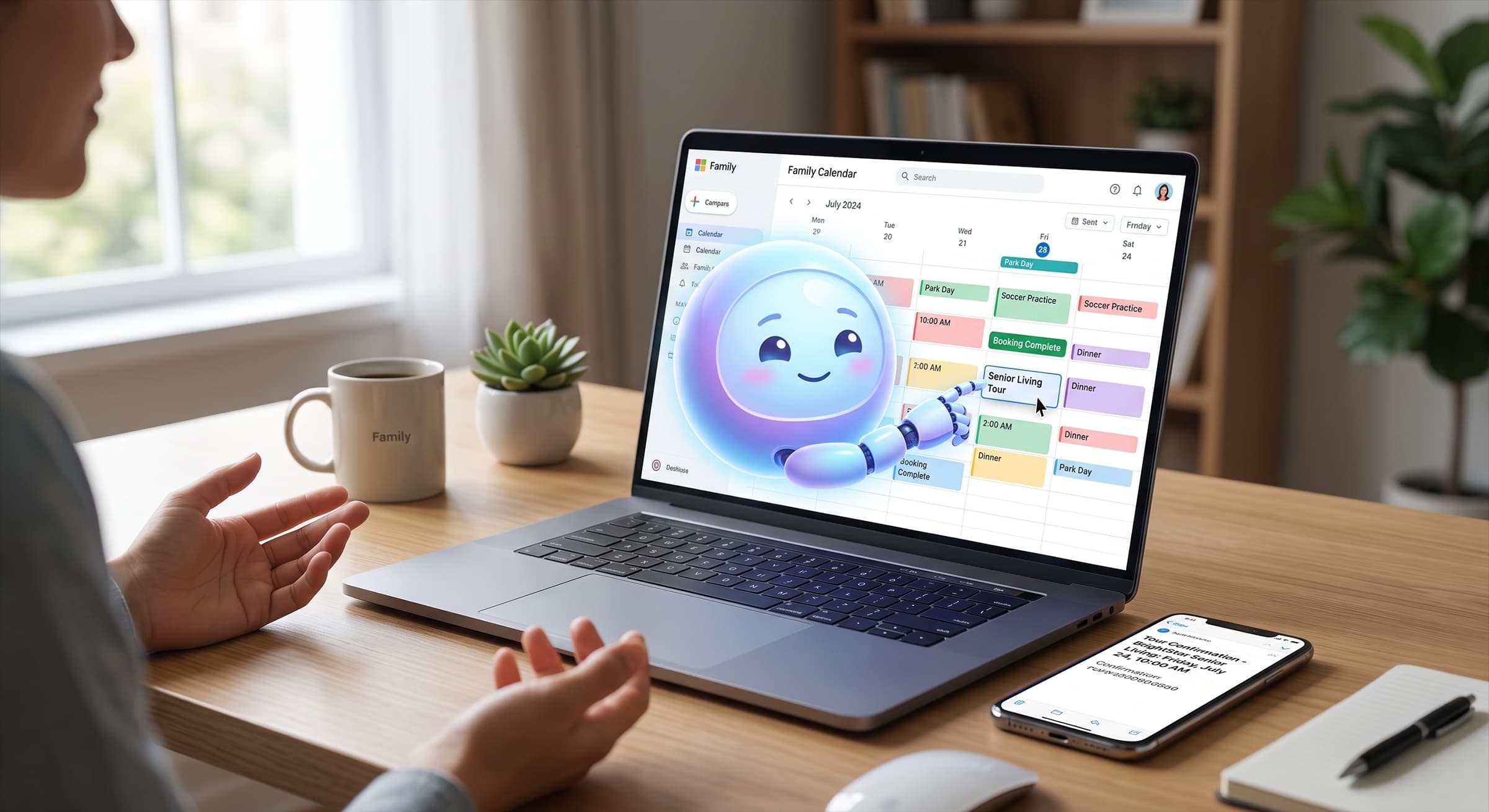
Soon she'll just type: "Find five assisted living communities near Dad with good reviews, get me brochures, and book tours around my calendar." Then hit enter and walk away.
Her AI does the rest. That's not sci-fi. Pieces of it are landing in 2026 and 2027.
Agents are going to talk to agents
Here's the shift under the hood.
Her AI assistant isn't going to browse your website the way she does. It's going to talk to your business directly, machine to machine.
It wants clean facts, fast. What care levels do you offer? What's your availability? Your reviews? Can it book a tour without a human in the loop?
If your business can answer those questions in a way a machine can act on, you're in the running. If it can't, you're invisible to the exact assistant families are starting to trust.
The plumbing being built right now
Let me get slightly nerdy, because this part matters.
There's a set of new standards taking shape that will let AI agents move and act across the web. Ways for your site to have a version for humans and a parallel version for AI. Ways for an agent to complete a task, even a booking, on someone's behalf.
The names will get fought over. The direction won't. Your online presence is about to have two audiences: people, and the agents acting for them.
I watch this closely for two reasons. One, how do we get clients cited and recommended by AI. Two, how does AI get built into their business so an agent can actually do something when it arrives. That second layer is what AI readiness is really about.
Here's the part that's good news for the little guy
You might assume this only helps the giants. Daniel made a point in our last session that flips that.
Google usually shows three local results. Three. So the top three get the calls and everyone else fights for scraps.
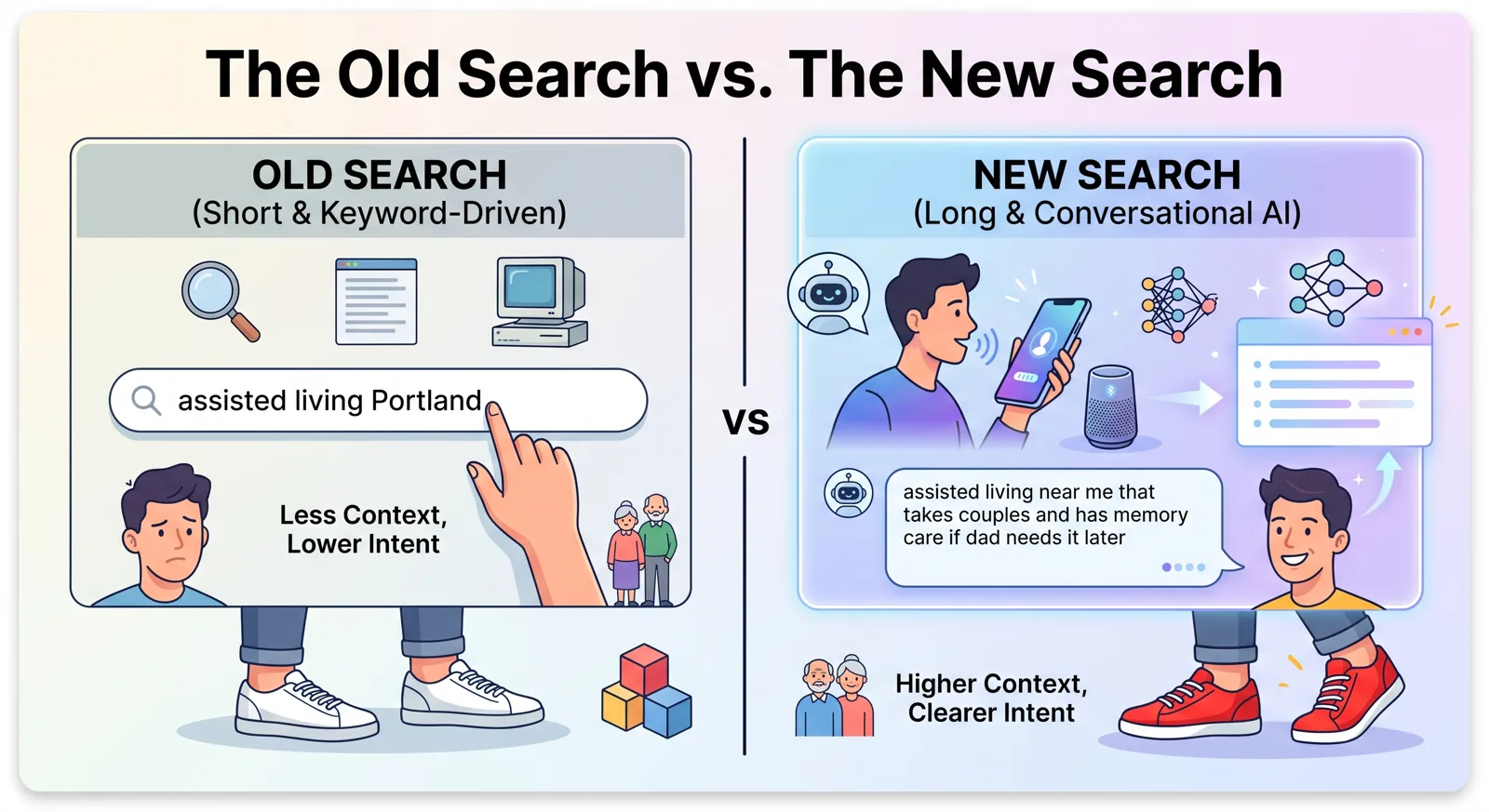
AI doesn't work like that. It can weigh a whole conversation and surface six or eight options, matched to what the person actually needs. Someone in a hurry? It might push the provider known for same-day response.
That means the leads could spread out more, not less. For a smaller senior care business that never cracked Google's top three, that's a real opening.
So what do you do today?
You don't need to chase every protocol. You need to be legible to machines and trusted by them.
Make your core facts crystal clear and consistent everywhere. Care levels, service area, hours, contact. Keep your reviews strong and your credentials public. Structure your site so it's easy to read, for a person and for a robot.
Do that, and whatever the exact standard turns out to be, you'll be ready to plug into it. That's the whole idea behind building AI visibility now instead of scrambling later.
The bottom line
The next big shift isn't people using AI to search. It's AI acting for them, all the way to booking the tour.
The brands that get chosen will be the ones a machine can read, trust, and act on.
Good news: getting ready for that is mostly the same work that already wins families. Clear facts, real trust, no clutter.
Want to know if an AI could actually recommend and act on your business today? Let's find out.
Frequently asked questions
- Will AI agents replace websites?
- Not entirely, but they'll change the website's job. Instead of only being browsed by people, your online presence will also be read and acted on by AI agents working for families. Businesses that make their information clear and machine-readable will stay findable; those that don't risk being skipped.
- How will families find senior living in the future?
- Increasingly by asking an AI assistant to research and even book on their behalf, rather than clicking through pages themselves. The assistant will favor businesses with clear, consistent information and strong third-party trust signals like reviews and credentials.
- Does AI search help small senior care businesses or hurt them?
- It can help. Traditional local search usually spotlights only the top three results, while AI can surface a wider set matched to a person's specific needs. That gives smaller, well-prepared providers a better chance to be recommended.
- What should I do now to prepare for AI agents?
- Get the basics machine-ready: consistent business facts everywhere, clear care-level and service details, strong public reviews and credentials, and a well-structured site. This makes you both findable and trustworthy to AI, whatever standards win out.