Here is a question that sounds small and is not.
You install an AI voice agent to answer your phones. A daughter calls at 4:40 on a Friday because her dad fell again and she cannot do another weekend alone.
The agent picks up.
Does it tell her it is not a person?
We spent a chunk of a team session on this last week, and we did not fully agree. That disagreement turned out to be the most useful part, so I am going to give you both sides and then tell you where we landed.
The case for not saying the word "AI"
Daniel is building one of these right now. He also built one for a locksmith earlier this year, so this is his second pass at the problem.
His setup does disclose, just not with the word you would expect.
The agent introduces itself with a real first name. It says it is a voice agent, that it is there to collect information, and that its job is to route the request to the right person.
Notice what is missing. It never says "AI."
Daniel's reasoning is worth sitting with. The word AI is loaded right now. People do not dislike AI because it is not a person. They dislike it because they have been stuck in a loop with a bad one, or watched one confidently make something up.
So "AI" imports a bad memory. "Voice agent" imports an expectation: this is a step, someone real is coming, and you are going to get there fast.
He also made a point that reframed the whole thing for me. This is a phone tree. That is all. If you have called a bank in the last twenty years you have talked to a machine before you talked to a human, and nobody was outraged, because the machine set the expectation and then delivered on it.
The case for saying it plainly
Eric went the other way, and he went there fast.
His argument: in senior care, being vulnerable is the name of the game. Families calling you are already exposed. They are scared and tired and often a little ashamed that it has gotten to this point.
So do not be clever with them.
His version sounds like this: "I'm an AI assistant. I can answer a lot of your questions, and I can get you to a real person. Let's start here."
Honest up front, capability stated, escape hatch offered.
His read is that a family will forgive the robot instantly if the robot is straight with them. What they will not forgive is finding out later that the warm voice they told their hardest story to was software. That is the moment your brand becomes the company that tricked them.
I think he is right that this is the actual risk. Not annoyance. Betrayal.
Where we landed
Both of them are solving for the same thing from different ends. Daniel is solving for the family not bailing in the first ten seconds. Eric is solving for the family not feeling deceived in minute four.
You need both, and you can have both.
Here is the structure we use:
- Disclose in the first sentence, not the third. Before you ask for anything, say what you are. A family should never discover it mid-call.
- Name the agent, and let it be a name. A name is not a deception if you have already said what it is. It gives people something to address, which makes the whole exchange less sterile.
- State the ceiling out loud. "I can answer questions about services, hours, and availability, and I can get you to a person for anything else." Now the family knows exactly what they are working with.
- Promise the handoff and keep it. The disclosure only works because a human is genuinely reachable. If the escape hatch is fake, none of this holds. Say how, and mean it.
- Use whichever words your families actually respond to. "AI assistant" and "voice agent" both work. What matters is that the sentence is early, plain, and true. If you want a head start on the vocabulary, here are the words families are actually listening for.
The same logic covers your website chat. If the bubble looks like a staff member, the widget needs a line near it saying what it is. Same rule, different channel.
Try this before your coffee is cold
Call your own main line right now, from your cell, like you are a stranger.
Time how long it takes to reach a human. Then ask yourself the only question that matters: if this were your mom, would you feel taken care of, or handled?
Whatever you just felt, a family felt it this week.
If you have a chat widget, do the same thing there. Type the worried, poorly-worded question a real daughter would type at 11pm and read the answer as her, not as the person who approved the copy.
The part that changed recently
There is a practical reason this question is landing on your desk now instead of in 2028.
Building one of these used to require a specialist. You wired up tools by hand, you guessed at fields, and things broke silently.
That is over. I went to set one up recently and hit a wall getting the scheduling tool to actually book a caller onto the calendar. There were a dozen configuration fields and no obvious culprit. So I described the problem in plain language to the platform's own assistant, and it found the misconfiguration and fixed it in about a minute.
The tools now build the tools. Which means the barrier is no longer technical skill. It is judgment.
Anybody can stand up a voice agent this month. Far fewer people will think carefully about what it says in the first four seconds to a woman who is out of options.
That gap is the whole ballgame, and it is the same gap we keep running into everywhere AI touches this industry. The tool is free. The judgment is not.
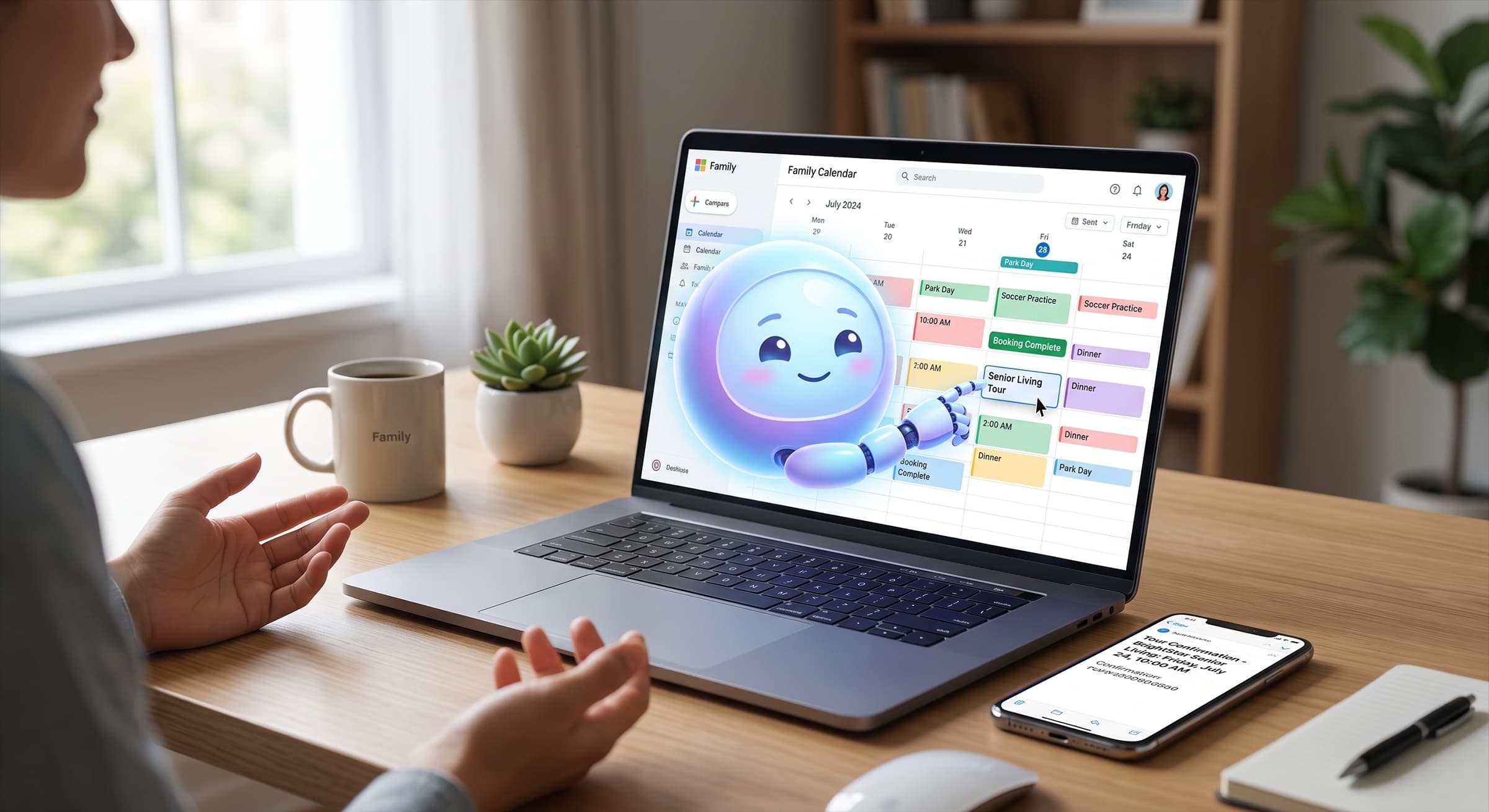
It also cuts the other direction. While you are deciding what your agent says on the way in, AI agents are already booking tours on families' behalf on the way out. Both sides of that call are becoming machine-assisted, which is a good reason to get your systems ready for this before it is urgent.
The bottom line
Do not hide it. Do not lead with a word that makes people flinch.
Say what it is, say what it can do, say how to reach a human, and then actually be reachable.
Families are not scared of technology. My grandmother video calls her great-grandkids. What families are scared of is being managed by a company that does not really see them.
Your phone is the first place they find out which kind you are.
We help senior-serving organizations get their whole intake path ready for this, from the first call to the follow-up, which is also how the first call fits the rest of the funnel. If you want to see where yours leaks, let's take a look together.
Frequently asked questions
- Should an AI answering service tell callers it is not a human?
- Yes, and in the first sentence. In senior care, families are calling during a crisis and trust is the entire product. Disclose immediately, state what the agent can and cannot do, and make a human genuinely reachable. The risk is not that a family is annoyed by AI. The risk is that they feel deceived after telling a machine something personal.
- Is it better to say "AI assistant" or "voice agent"?
- Both disclose honestly, and either is defensible. "AI" is the clearer term and some families respond well to the directness. "Voice agent" carries less baggage for people who have had bad experiences with AI, and it frames the call as a routing step rather than a replacement for a person. Test which one your callers respond to. What matters most is that the disclosure comes early and that the promised handoff to a human is real.
- Can an AI receptionist have a human name?
- Yes, as long as it has already said what it is. A name gives callers something to address and makes the conversation feel less mechanical. The problem is never the name. The problem is a name used in place of disclosure, so the caller believes they are talking to staff.
- Will families accept an AI answering the phone at a senior living community?
- Many will, if it is honest and fast. Families are not calling to admire your technology. They are calling to get help. An agent that discloses what it is, answers basic questions accurately, and connects them to a person quickly usually clears the bar. An agent that stalls them, guesses at answers, or hides what it is will cost you the inquiry and possibly the review.
- What should an AI voice agent never do in senior care?
- It should never give clinical guidance, never claim to be a caregiver or nurse, and never be the only path into your organization. It should also never pretend a human is unavailable when one is. Route anything involving health, medication, safety, or urgency to a person immediately.