Here is something that happens constantly and almost nobody warns you about.
You run a Google Ads campaign for one assisted living community. It works. Good cost per lead, steady tour requests, the sales team is happy.
So you copy it. Same structure, same keywords, same ad copy, same budget, new community 40 miles up the road.
And it does not perform. Not close.
Same agency, same platform, same everything you can see on the screen. Different result.
We have watched this play out enough times that it stopped being surprising and started being informative. Here is what is actually going on, and why it matters a lot right now.
The AI promise, and the part that can't be true
There is a pitch going around that AI is about to run your campaigns for you. Describe your business, hit go, let the machine optimize.
Some of that is real. The tooling has genuinely gotten better, and we use it every day.
But there is a ceiling built into the premise, and it is worth saying plainly.
Imagine ten assisted living communities in the same region all sign up for the same AI-driven ad product. All ten type in roughly the same thing: we want more move-ins.
The system builds ten very similar campaigns. Similar keywords, similar copy, similar bids. It has to, because it was given similar inputs and it is optimizing toward a similar goal.
Now all ten are bidding against each other in the same auction, for the same families, saying nearly the same thing.
They cannot all win. That is not a limitation of the technology, that is arithmetic. An auction has a distribution of outcomes. Making everyone's campaign equally competent does not lift everyone, it just raises the price of the click and moves the fight somewhere else.
So the question stops being "can AI build a good campaign." It can. The question becomes "what are you feeding it that the other nine are not."
That part is still a human job, and we do not see that changing soon. It is the same argument for hiring people who know the industry even in an era of very good AI.
The four variables that actually differ
When a duplicated campaign underperforms, it is almost never the ad copy. It is one of these.
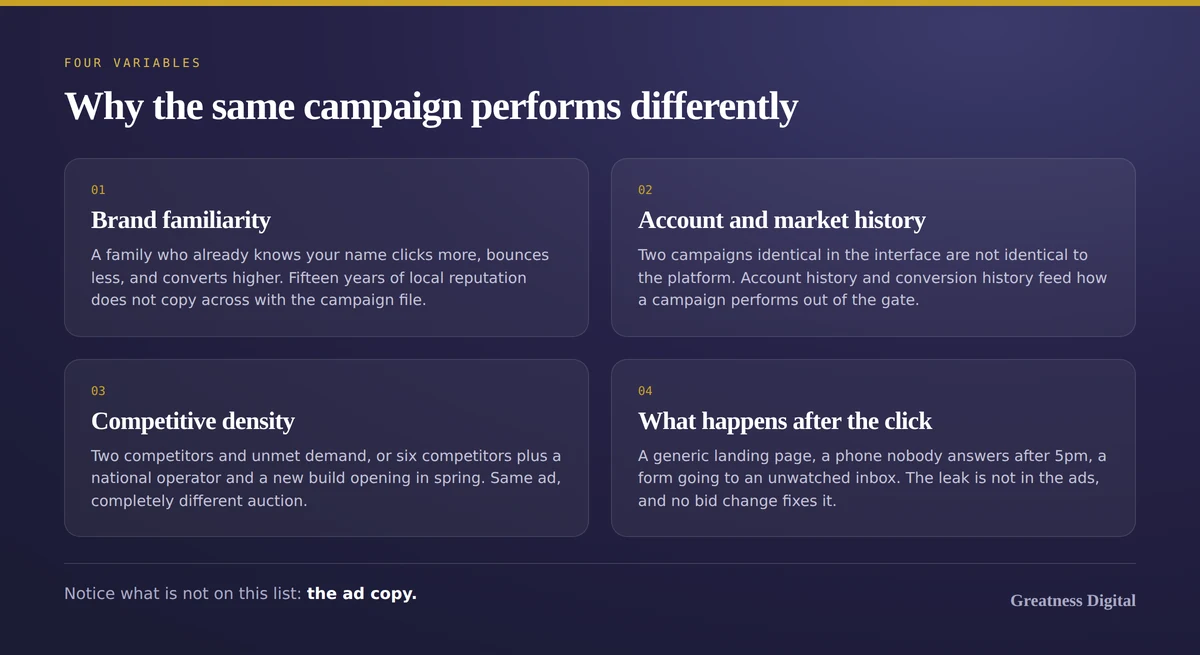
1. Brand familiarity.
This is the big one and the most underrated. If a family has heard of your community before they see your ad, they behave completely differently. They click more, they bounce less, and they are measurably more likely to actually fill out the form rather than just browse.
A campaign that worked at Community A may have been quietly riding fifteen years of local reputation, a strong referral network, and a recognizable name. Copy the campaign to Community B, which opened two years ago and nobody has heard of, and you have copied the ads but not the thing that made them work.
2. Account and market history.
Two campaigns that look identical in the interface are not identical to the platform. Account history, conversion history, and the competitive landscape of that specific geography all feed into how a campaign performs out of the gate. We see the same setup behave differently across accounts often enough that it is a planning assumption, not an anomaly.
3. Who you're actually competing with.
Your region might have two competitors and a lot of unmet demand. Forty miles up the road there might be six communities, one of them a national operator with a budget you cannot match, plus a new build opening next spring that is advertising aggressively to fill.
Same ad. Completely different auction.
4. What happens after the click.
This is where most senior living campaigns quietly die. The ad works fine. The landing page is generic, the phone goes unanswered after 5pm, or the form goes to an inbox nobody checks on weekends.
We audited a client's call data recently and found a large share of ad-driven calls going unanswered or landing in the wrong place. No amount of campaign optimization fixes that. The leak is not in the ads.
Why this is good news
If campaigns were purely a function of budget and platform skill, the biggest operator in your market would win every time, permanently.
They do not, because the variables above are things you can actually influence.
You can build brand familiarity. That is reviews, referral relationships, local press, showing up in the community, and being the name a discharge planner says out loud. It compounds, and it makes every ad dollar you spend afterward work harder. It is also most of what decides whether an AI assistant names you when a family asks who to trust in your area.
You can fix what happens after the click. Answer the phone. Route sales calls to a line somebody actually picks up. Make a landing page that matches the ad instead of dumping people on the homepage.
You can give the machine better inputs. Specific differentiators, specific service areas, specific programs. The positioning work that makes your ads sound like you rather than like the category.
None of that is exotic. It is just not push-button.
The honest version of the AI question
We are optimistic about these tools. We build with them daily and they have made us meaningfully faster.
But "AI will run your ads" and "AI will make your ads win" are different claims. The first one is mostly true already. The second one cannot be true for everyone in the same market at the same time, and any vendor telling you otherwise is selling you the auction, not an advantage.
The advantage is still the same thing it has always been: knowing something about your community that your competitor does not know about theirs, and getting that into the campaign. If you cannot name that thing yet, start there, because no amount of bid management substitutes for it.
The machine is very good at execution. It has nothing to say about what makes you worth choosing.
That part is still yours.
We work only with businesses that serve seniors: senior living communities, home care and home health agencies, senior placement advisors, elder law firms, and senior move managers. If you serve seniors, we serve you.
Campaign working in one market and not another? We will tell you which of the four it is. Let's talk.
Frequently asked questions
- Why does the same Google Ads campaign perform differently at two similar communities?
- Four variables usually explain it: existing brand familiarity in each market, the account's and market's history, the specific competitive density of each geography, and what happens after the click, meaning landing page quality, call answering, and response speed. The ad copy is rarely the cause. A campaign that succeeded at an established community may have been drawing on local reputation that does not transfer with the campaign file.
- Can AI run assisted living ad campaigns without a marketing team?
- AI can build and manage a competent campaign. What it cannot do is make every advertiser in the same auction win, since competing communities feeding similar inputs get similar campaigns and then bid against each other. The differentiating work, deciding what is genuinely distinct about your community and getting that into the campaign, still requires someone who knows the business.
- What's a realistic cost per lead for senior living Google Ads?
- It varies widely by market density, care level, and brand recognition, so any single number quoted without context is a red flag. What matters more than the benchmark is the trend in your own account and whether leads convert to tours. Ask your agency what your cost per tour is, not just cost per lead.
- Why are my ads generating calls but not move-ins?
- Usually a post-click problem rather than a campaign problem. Common causes: calls going to a main line instead of a sales line, no after-hours coverage, a landing page that does not match the ad's promise, or slow follow-up. Audit your call recordings and response times before changing anything in the ad account.
- Does brand recognition affect paid ad performance?
- Yes, significantly. Families who recognize your name click at higher rates and convert at higher rates than families seeing you for the first time. This is why reputation work, reviews, referral relationships, and AI visibility make paid campaigns more efficient rather than competing with them for budget.