Most senior care businesses are not bad at getting reviews. They have simply never decided what good looks like.
So let me put a number on it, and then tell you about the client who hits it.
The benchmark
I asked Eric what a fair number of reviews is for a business doing good work. Not a rule. An expectation.
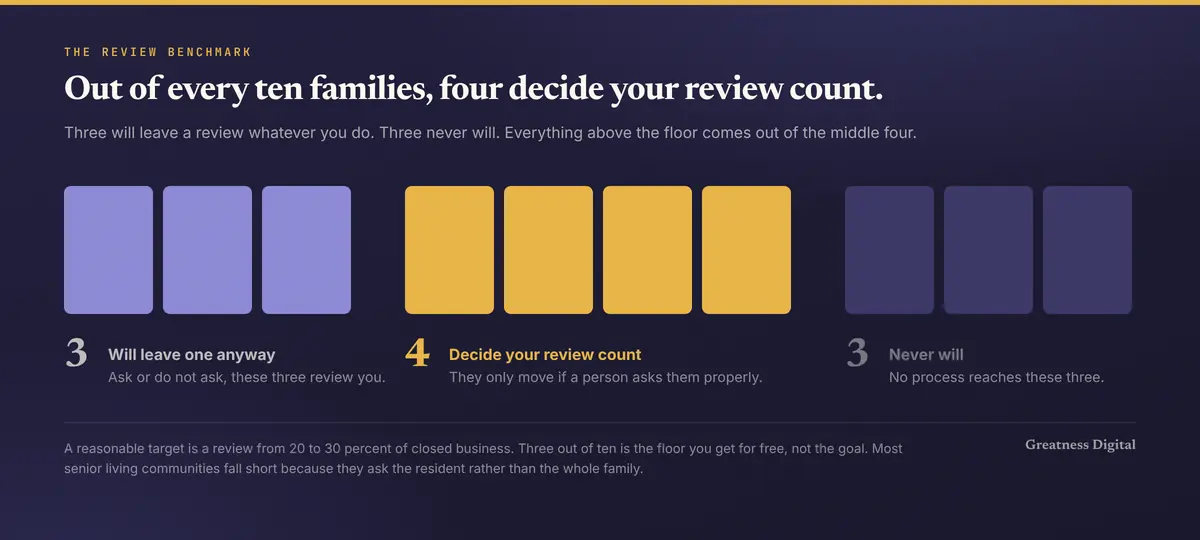
His answer: you should be getting a review from twenty to thirty percent of your closed business.
The reasoning comes from an old sales idea he applies to almost everything. Out of ten clients, three will do what you ask automatically. Three never will, no matter what you do. The four in the middle decide the outcome, and they only move if somebody works on them.
So if ten families move in this month, three reviews is the floor, not the ceiling. Everything above three comes out of the middle four.
Then I asked whether our senior living clients hit that.
He said no. He thinks they fall short, and he thinks the industry makes it harder on itself than it needs to be.
The mistake almost everybody makes
Communities chase the resident.
They want the review from the person who moved in. That feels right. It was their experience.
But Eric's point is that the resident is often not where the best review is going to come from, and more to the point, they were not the only person in the room.
When his wife's family moved their mother into a community, there were seven sisters involved in the decision.
Seven people went through that experience. Seven people formed an opinion about how it was handled. The community was trying to get one review, from one of them.
You do not need all seven. But you already have their phone numbers and their email addresses, because you collected them during the move in. One message to the family, after it is done, gets you a far better chance than one ask to one person.
Collect every contact up front. You can even say why. We want to make sure everyone in the family has the same information. That is true, and it also leaves you with a list.
The client who actually does this
1st CHOICE Advisory Services has been helping Northwest families since 1993.
They get between fifteen and twenty new Google reviews a month.
Month after month. It is the best review performance in our book of clients and it is not close.
Daniel found the reason, and it is not a tool.
They have a quality assurance person.
Earlier this week their owner emailed asking where his quality assurance person should be sending people to leave a review, because he wanted to make it easier for her. That sentence is the whole answer. There is a human being whose job includes following up after a placement, and the review ask lives inside that follow up.
The process, as Daniel describes it
The structure matters as much as the person.
Two to four days after the work is done, somebody reaches out. Not immediately, because the family has not had time to sit with the decision yet.
The call is not a review request. It is a check in. How have things been. Is there anything we can do.
Most people, if nothing is wrong, say something positive. That is the moment.
Then you say something like: a lot of our business comes from referrals, and after referrals, people hear about us online. We would love for you to say something about your experience.
And if something is wrong, you now know about it, and you go and fix it instead of discovering it in public.
Daniel was careful about this last part and I am keeping his caveat in. Routing people based on whether their first reaction was positive edges toward review gating, which is not technically recommended. He is right to flag it. The version that stays clean is that you ask everybody, and the conversation just happens to surface problems before they become one star reviews.
His summary is the part I would put on a wall. Businesses with a strategic process for generating reviews are going to run circles around anybody that does not.
The cheapest version of this
Not every business can staff a quality assurance role.
Eric's floor is a thank you card with a QR code on it. Thanks for trusting us with your mother. Scan this and tell people how it went.
It costs about a dollar to send.
He pointed out that most communities send nothing at all after a move in. No thank you, no follow up, nothing. Which is strange, because that is the single easiest moment to ask for anything.
Automated text messages with a direct review link are the other baseline. Daniel has set those up for years and they do work. They just work less well than a person.
While we are here: your reviews are probably being filtered, not deleted
One more thing, because it comes up constantly and almost nobody knows the answer.
We watched a client's Google review count drop from 277 to 261. Sixteen reviews, gone, with no explanation and no notification.
Here is what is usually happening. Google is not deleting them. Google is filtering them, which means they stop showing on the public profile while still existing.
Daniel demonstrated this using a tool that snapshots every review through the Google Places API and runs a difference check on a schedule. When a review drops off the front end, you can see exactly which one went.
And then you can do something about it. There is a redressal form where you ask Google to look at the specific case, and in Daniel's experience you generally have success with it if you have any documentation at all that the person was a real customer.
Which means two things. First, the review count you are watching is not a reliable record of the reviews you earned. Second, a filtered review is recoverable, but only if you noticed.
Most businesses never notice. There is no alert. The number just goes down.
The part where I admit something
Here is the uncomfortable conclusion.
We are a digital marketing agency. We can build the automation, wire up the text messages, fix the Google Business Profile, and build a tracker that catches filtered reviews.
None of that is the thing that works.
The thing that works is a person picking up the phone four days later, asking how it went, and then asking. 1st CHOICE does not outperform everybody else because they bought better software. They outperform because they staffed it and they take it seriously.
That is not a service we sell. It is a decision you make about how your business runs.
What we can tell you is what it is worth. More reviews mean more visibility, more visibility means more families, and in the AI answers families increasingly ask first, your review profile is one of the things being read back to them.
Two things are underestimated in this industry, consistently. How valuable reviews actually are, and how much personal effort it takes to get one.
What to do this month
Pick your last ten closed families. Not your last ten residents. Families.
Find every contact you collected during the move in. Send one message, to all of them, that thanks them and asks.
If three of those ten respond, you are at the floor. If you get to five, somebody on your team is working the middle four properly, and you should find out who it is and let them keep doing it.
Greatness Digital is a digital marketing agency in Oregon that works only with businesses that serve seniors: senior living communities, home care agencies, placement advisors, elder law firms, and senior move managers.
Want help building the ask into how your business already runs? Let's talk.
Frequently asked questions
- How many Google reviews should my business be getting?
- Aim for a review from twenty to thirty percent of your closed business. The reasoning: out of ten customers, three will leave one automatically, three never will, and the four in the middle only move if somebody asks them properly. Three out of ten is the floor, not the target.
- Why did my Google reviews disappear?
- They were probably filtered rather than deleted. Google removes reviews from the public profile without notifying you, and the review often still exists. You can file a redressal form asking Google to look at the specific case, and it generally succeeds if you have documentation that the reviewer was a real customer. The problem is that there is no alert, so most businesses never notice the count moving.
- Should I ask the resident or the family for a review?
- The family, and all of them. A single move in often involves several adult children who each formed an opinion about how it was handled. You already collected their contact details during the process. Asking one person when six were involved is the most common reason communities underperform on reviews.
- When is the best time to ask for a review?
- Two to four days after the work is done. Any sooner and the family has not had time to sit with the decision. Make the first contact a check in rather than a request, and ask for the review once the conversation is already positive.
- Is review gating allowed?
- Routing people to a review link based on whether their feedback was positive is not recommended and can put your profile at risk. The clean version is to ask everyone, while making the first contact a genuine check in, so problems surface in conversation rather than in public.