The person searching for care is rarely the person who needs it.
If you provide any kind of care across senior living and home care, the first call is almost always from the same person.
The daughter.
Sometimes she lives in another state. Often she's working full time and raising her own kids. And she's either making the decision or heavily shaping it.
That's not just a hunch. AARP and the National Alliance for Caregiving's 2025 Caregiving in the US report found that three in five family caregivers are women, and the average caregiver is 51 years old.
An assisted living operator we talked with recently said it out loud, without us asking: the daughter is the decision maker.
I saw it firsthand, too. I spent four years as community relations director at Compass Senior Living in Eugene, Oregon, including a year working through COVID. Here's what I learned about her, and what it means for your marketing.
Independent living is a little different
To be fair, not every senior living sale looks like this.
Retirement communities and independent living do get explored by seniors themselves. Mom and dad are touring because they want a change.
But the moment there's a care element, the daughter steps into the lead role.
She starts with a story
When a daughter walked in for a tour, she didn't open with questions about price or amenities.
The first thing I'd ask was, "So what brings you in? Tell me what's going on with mom and dad."
And she'd tell the story. Something had happened. A fall, a scare, a worried call. Whatever it was, it's the reason she was standing in front of me.
Her first real questions always came out of that story:
- How do you keep people safe?
- Will she still have a good quality of life?
- Will she be bored?
- What happens if something goes wrong at 2am?
Every one of those is fear.
So the job isn't to answer a list of questions. The job is to calm the fear and build trust. If you do that, the questions take care of themselves.
Your website has one job: help her picture it
We're building a new website right now for Prestige Senior Living, which manages more than 20 communities. Their team said something I keep repeating.
Families need to see themselves in the space.
When building a website for a community, we’re not just showing pretty rooms. We’re showing residents in those rooms.
If mom loves books, show a resident reading in a sunny, cozy nook. If dad loves being outside, show the garden with someone actually in it. If she's the social one, show the dining room full and loud.
The daughter scrolling your site late at night is trying to answer one question: could mom be happy here?
Paint that picture for her.
The website's first job is to reach the heart, not the spreadsheet. The logic comes later.
That said, she will look at the money. On the senior living sites we manage that publish pricing, the pricing page is usually the third most visited page on the site. Don’t make her hunt for it, and it is worth deciding deliberately whether to publish a starting price at all.
The message that works for her and fails with mom
This is where a lot of senior care marketing goes sideways.
Messaging that lands with adult children is about safety, consistency, thoroughness, and care.
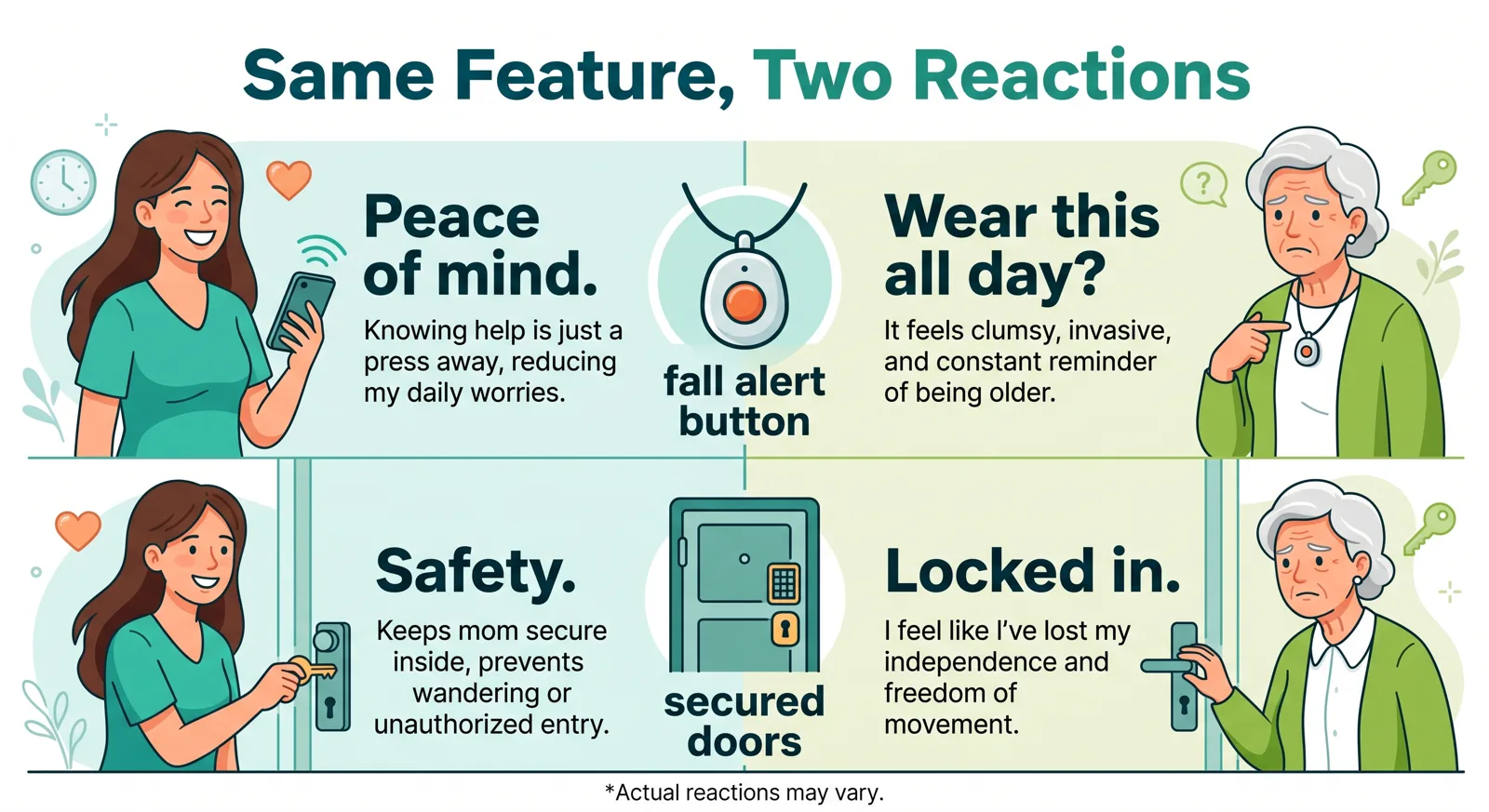
Take a fall alert button. The kind someone wears around their neck.
To the daughter, that's huge. Her biggest fear is mom falling and lying there with no one knowing. A button that gets help right away? That's peace of mind.
Now say the same thing to mom: "Wear this button around your neck all day."
Not nearly as attractive.
Same with secured doors and wander prevention in memory care. To the daughter, that's safety. To the resident, it can sound like being locked in.
Neither reaction is wrong. They're just different people with different fears.
So know who each piece of marketing is for:
- For the daughter: safety, consistency, how you'll keep her informed, what happens in an emergency.
- For the senior: independence, friendships, things to do, keeping the parts of life they love.
Your website, ads, and tours will usually need both. Just don't hand mom the brochure written for her daughter.
Why families pick someone else
When we hear from sales teams about lost families, the reasons usually sound like this: they went with the newer community, the cheaper one, the one with better amenities.
Sometimes that's true.
But often, it's a sign the sales conversation never got to what makes the community special. The culture. The care process. The staff. The way they handle the 2am problem.
If those aren’t front and center, families compare what they can see. And what they can see is square footage and price. Getting that out of your team’s heads and onto the page usually means you start with an interview.
Try this
Open your homepage on your phone.
Pretend you're a 51-year-old daughter, the age of the average family caregiver, who just got a call that her mom fell.
Within ten seconds, does the site tell you she'll be safe? Within thirty, can you picture her happy there?
If not, that's your next project.
Greatness Digital is a digital marketing agency in Oregon that works only with businesses that serve seniors: senior living communities, home care agencies, placement advisors, elder law firms, and senior move managers.
Want a second set of eyes on how your site speaks to families? Let's talk.
Frequently asked questions
- Who usually makes the decision on assisted living?
- For communities that provide care, it's most often an adult child, and very often a daughter. AARP and the National Alliance for Caregiving report that three in five family caregivers are women, and the average caregiver is 51. Independent living and retirement communities are more likely to be explored by the seniors themselves.
- How should assisted living communities market to adult children?
- Focus on safety, consistency, communication, and quality of care. Show residents enjoying real spaces so families can picture their parent there, and make pricing easy to find.
- What should a senior living website show?
- Real residents in real spaces, the daily life a parent could have, how the community keeps people safe, and a clear next step to call or tour. The goal is helping families picture their loved one there.
- Why does safety messaging sometimes turn seniors off?
- Features that reassure adult children, like fall alert buttons or secured doors, can feel like a loss of independence to the senior. Use safety messaging for families and independence and lifestyle messaging for seniors.