A home care agency came to us a few weeks ago wanting a new website.
Standard request. They liked most of what they had. Move it over, clean it up, make it modern.
We could have done exactly that. Taken the existing site, restructured it, made it faster and prettier, shipped it in two weeks. That is what most people mean when they ask for a redesign.
Instead we got on a call and asked the owner why he started the business.
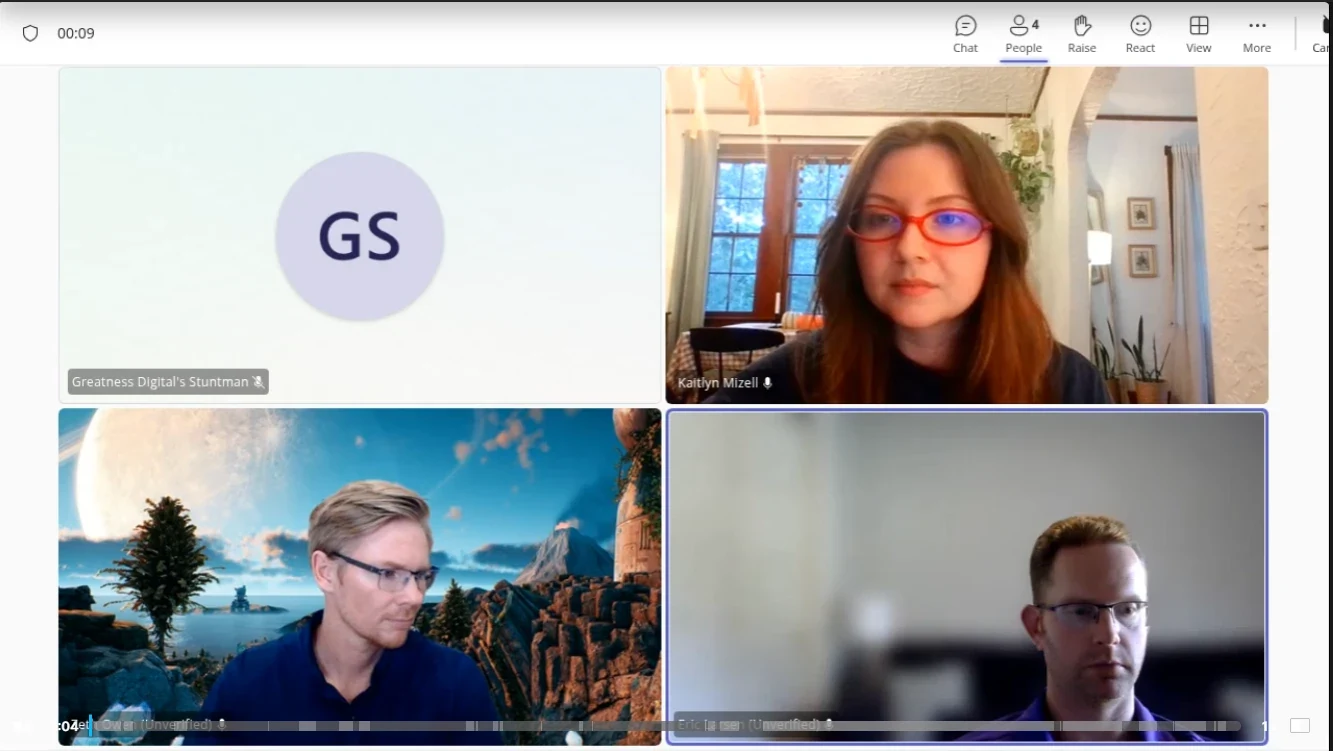
This is the whole method. Not a design review, not a sitemap, not a moodboard. A recorded conversation, about thirty minutes, where somebody who does not already know the answers asks until something real comes out.
That conversation ran about 30 minutes. By the end of it we had something like 20 to 25 distinct selling points, messaging angles, and brand differentiators.
Almost none of them were on his website.
The gap nobody talks about
Here is what was sitting in that transcript and not on the site.
Specific certifications his caregivers hold. Specific trainings his team completes that competitors in his market do not offer. The reason he picked this work in the first place, which was personal and specific and would make any family reading it feel something. A story about a client whose situation genuinely turned around because of the care his team provided.
Any one of those beats the entire homepage he was running.
So why were they not there?
Because a web designer who did not know his business built something that looked nice. And he looked at it and said, yeah, that looks nice.
That is the whole failure. It is not incompetence. It is the wrong process.
You don't review your business. You answer questions about it.
This is the part worth sitting with.
When somebody hands you a draft of your own website, you are in review mode. You are checking whether it is wrong. You are scanning for typos and bad photos and colors you do not like.
Review mode does not produce information. It produces approval.
Nobody sits down in front of a finished page and thinks, oh, I should mention that we are one of a handful of agencies in the state with this particular contract. That is not how memory works. That detail only surfaces when somebody asks you a question that reaches for it.
You do not review your business. You answer questions about it.
Get the order wrong and you end up with a site that looks professional and says nothing. Which is most senior care websites. It is the difference between a site that sells and a brochure that happens to be online.
Why this matters a lot more in 2026
AI can now produce a competent-looking website in an afternoon. Clean layout, reasonable copy, decent photos.
That is not a threat. That is a floor. Everybody has it now.
Which means the finished look of your site has stopped being a differentiator. If your competitor down the road can generate the same thing by Friday, the design is not what wins.
What wins is the stuff only you know.
AI slop is not caused by using AI. It is caused by feeding a generator nothing but what is already on the internet. Put a generic prompt in, get a generic site out. The machine did not fail. It had nothing to work with.
The fix is not avoiding the tools. The fix is showing up with material nobody else has.
That material lives in your head, and the only way out is a conversation.
This matters for AI visibility too. When a family asks ChatGPT who to trust for home care in your county, the answer gets built from what the web can actually confirm about you. "We have licensed caregivers" confirms nothing. It is a sentence every competitor also has. The specific training, the specific contract, the specific program name, that is what an AI can lock onto and repeat.
The questions
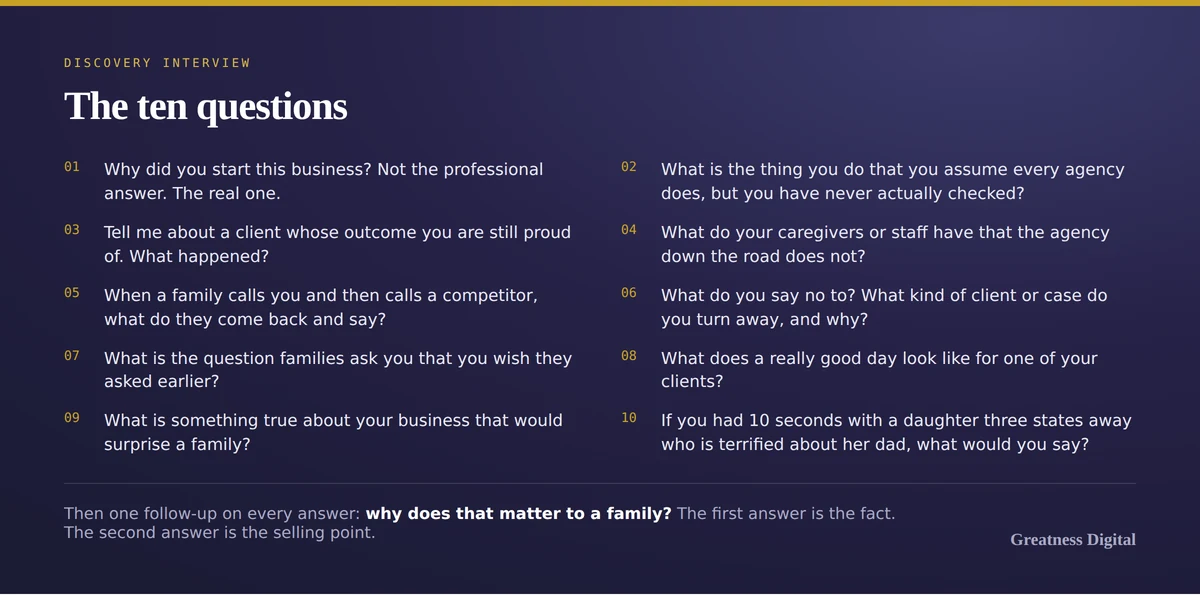
Here is the actual list. Take it and run it on yourself, or hand it to whoever is building your site.
Record the call. Do not take notes, you will miss things and you will steer the conversation toward what you already planned to say.
- Why did you start this business? Not the professional answer. The real one.
- What is the thing you do that you assume every agency does, but you have never actually checked?
- Tell me about a client whose outcome you are still proud of. What happened?
- What do your caregivers or staff have that the agency down the road does not? Certifications, training, programs, tenure.
- When a family calls you and then calls a competitor, what do they come back and say?
- What do you say no to? What kind of client or case do you turn away, and why?
- What is the question families ask you that you wish they asked earlier?
- What does a really good day look like for one of your clients?
- What is something true about your business that would surprise a family?
- If you had 10 seconds with a daughter three states away who is terrified about her dad, what would you say?
Then one follow-up on every answer: why does that matter to a family?
That question is where the good stuff comes out. The first answer is the fact. The second answer is the selling point.
What to do with the answers
You will come out of a 30-minute conversation with far more than a homepage can hold. That is the point. Sort it.
The emotional origin story and the strongest client outcome go on the homepage and the About page.
Certifications, training, and programs become their own page or a trust section. These are the extractable, factual claims, so write them plainly. Say the actual name of the program.
The things families come back and say become your headline and your subheads. That is language you did not have to invent.
What you say no to becomes a differentiator, and it is the one almost nobody uses. Turning away the wrong client is a trust signal.
Every answer to "what would surprise a family" is a blog post.
Where this is going
We think web design is heading toward conversation.
Not chat interfaces. Conversation as the input. The build starts with an interview, the interview produces the brand, and the brand produces the site.
Layout last, not first.
If you are about to spend real money on a new website for your home care agency, senior living community, or placement practice, do the 30 minutes first. It is the first thing we do on every in-home care website we build. Record it. Send the recording to whoever is building the thing.
Worst case you learn something about your own business. Best case you stop paying for a site that looks nice and says nothing.
We work only with businesses that serve seniors: senior living communities, home care and home health agencies, senior placement advisors, elder law firms, and senior move managers. If you serve seniors, we serve you.
Want the interview run properly, with the transcript turned into an actual website? Let's talk.
Frequently asked questions
- What should a home care website include that most of them don't?
- Specific, verifiable differentiators: named certifications and trainings your caregivers hold, named programs you run, the specific populations or conditions you specialize in, and at least one real client outcome told as a story. Most home care websites list services and a phone number, which every competitor also has. The specifics are what families remember and what AI search engines can actually confirm and repeat.
- How do I keep my website from sounding AI-generated?
- Give the writing process material that is not already on the internet. AI-generated content sounds generic when it is built from generic inputs. Start with a recorded 30-minute interview with the owner or director, pull the specific stories, numbers, certifications, and opinions out of it, and build the copy from that. The tool is not the problem. The input is.
- What questions should I answer before redesigning my senior care website?
- At minimum: why you started, what your team has that competitors do not, a client outcome you are proud of, what families say after they have shopped around, and what kind of client you turn away. Then ask why does that matter to a family after every answer. That follow-up turns a fact into a selling point.
- How long does a website discovery interview take?
- About 30 minutes is enough to surface 20 or more usable messaging points. Record it rather than taking notes, since the useful details tend to arrive as asides and are easy to miss in real time.
- Who should be interviewed, the owner or the marketing director?
- The owner or founder, if they are still involved. The origin story and the strongest convictions usually live with them. Interview the care staff separately if you can, since they hold the day-to-day specifics that make a site feel true.