In this article
Ask your marketing agency one question this week.
What counts as a lead, and how exactly do you track it?
Eric has been asking that question of every account he inherits for years, and it is the fastest way to find out whether the numbers you have been shown mean anything. Most of the time the answer arrives slowly, with some throat clearing.
Here is why it matters so much.
The hundred leads that were page views
The most common version of this is the simplest. An agency reports a hundred leads. You feel good about a hundred leads.
Then you find out a lead was a page view.
Eric's words: "We got you 100 leads, and then it's a page view." It is not fraud exactly. Somebody set a conversion on a URL, the URL got visited a hundred times, and the dashboard dutifully reported a hundred conversions. Nobody filled anything in. Nobody called.
A page view is not a lead because it does not move anyone through anything. It is the digital equivalent of counting people who walked past your building.
Even a real form fill might not be the thing you want
Here is the subtler version, and it catches good agencies too.
A senior living community gets a form fill. That is genuinely useful. You have a name and a phone number and somebody raised their hand.
But they did not book a tour.
They might have been asking a question about a tour. They might have been comparing four communities and submitting to all of them. For a community whose entire sales motion runs on getting a family through the door, a form fill and a booked tour are not the same event and should never carry the same weight.
We learned this the hard way on one of our own accounts. We had set the conversions up correctly. Contact form, tour request, phone call, all marked as conversions, all firing properly.
What we had not done, for longer than I would like, was assign them different values. So Google's algorithm optimised as though a question about parking was worth exactly as much as a family asking to visit on Saturday.
That is not a tracking failure. Everything was working. It was a definition failure, which is harder to see because nothing looks broken.
If you run a community, our Senior Living Marketing page covers the wider picture.
Two systems, one month, four numbers
In October we were reviewing paid performance with a client who also runs her own marketing platform.
Our system showed zero leads from Bing and eighteen from Google.
Her system showed three from Bing and five from Google.
Same month. Same client. Same campaigns. Four numbers, none of which agree with any other.
Our best guess is that our side is double counting Google, probably from people revisiting a brochure page. Hers may be missing attribution on the Bing side. But the honest position is that we were two competent systems watching the same thirty one days and producing irreconcilable accounts of what happened.
If you are making budget decisions off one of those numbers, you are making them off something closer to a weather forecast than a measurement.
How tracking actually breaks
Three real failures from our own book of clients this autumn, all found within a few weeks of each other.
The tag nobody knew about. One community had a Google Ads conversion tag hard coded into the site in October 2023. Nobody currently working on the account put it there. It had been quietly inflating conversions for two years alongside the proper setup.
The rule that counted everybody. The same site had a tag manager rule flagging every single visit to the brochure page as a lead, rather than only the visits that came from ads. So the account was producing false positives and, separately, missing two of three recent genuine form conversions. Both directions at once.
The spend with nothing on the other end. A franchise client was running real money through Google Ads and Meta with zero recorded conversions on either platform. Not low conversions. Zero. Meanwhile a competing lead generation service was taking credit for everything that came in, because they could at least produce a number.
None of these were visible from the dashboard. All three accounts looked like they were working.
Why nobody checks
This is the part I find most interesting, and the answer is uncomfortably simple.
If an owner opens their analytics and sees numbers moving, they conclude it is fine. Data is flowing, therefore data is correct. Nobody audits a system that appears to be running.
And agencies have their own reason to leave it alone. Eric put it plainly: they are afraid that if they tell a client "I am not really able to track anything here," the client will leave.
So the conversation does not happen, and everybody proceeds on numbers nobody has verified.
We are month to month with every client we have. There is no annual contract to hide inside. That forces the opposite behaviour, because if we cannot show what is working we have no argument for being here next month. Having to prove it every thirty days is a better discipline than any reporting template.
Sometimes the platform will not let you track it
There is an honest category of failure worth naming, because it is not anyone's fault.
Some systems simply will not report back. Certain healthcare booking platforms give you a click and nothing else. You cannot see whether the appointment happened. Several senior living CRMs are the same.
One of our communities had to buy expensive middleware purely to get attribution to flow from their website into their CRM. That is a real cost, incurred for no reason other than that two pieces of software do not talk to each other.
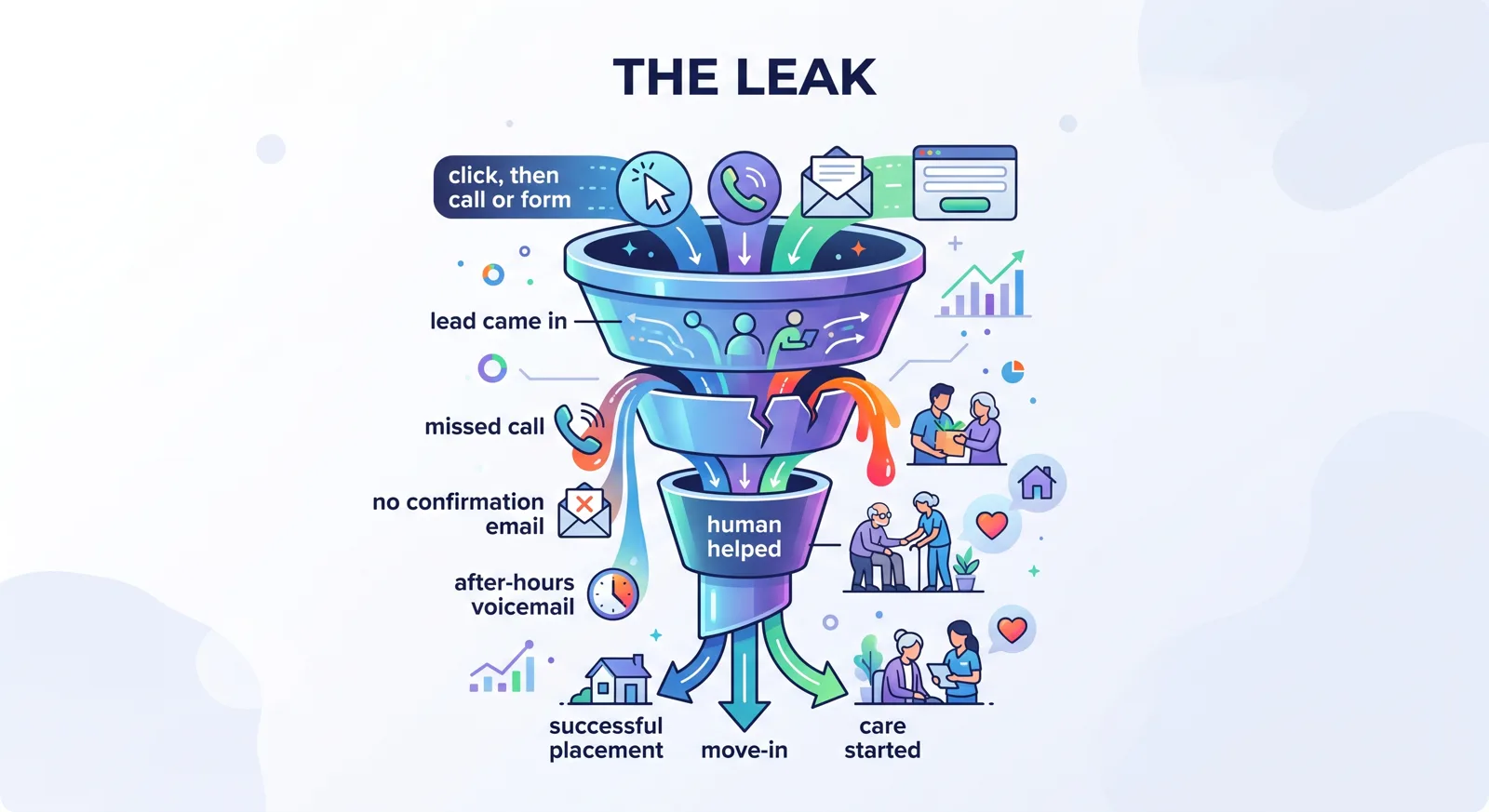
And that is still only halfway. The next level, which almost nobody in senior living is doing, is tracking past the booked tour to the actual move in. That is the only number that matters to the business, and it sits in a CRM the marketing stack usually cannot see.
If an agency tells you this is hard, they are being straight with you. If they tell you it is already solved, ask them to show you a move in attributed to a campaign.
A tracked lead only helps if someone answers it quickly, and we put together a speed-to-lead checklist for that.
What to do this week
Three things, in order.
Ask the question. What counts as a lead in this account, and what fires that conversion? If the answer involves a page view, you have found your problem in one sentence.
Ask for the weights. If every conversion in your account is worth the same, the algorithm is optimising for the cheapest one. That is usually the least valuable one.
Submit your own form. Fill in your own contact form, from your phone, off your office network. Then check whether it appears in analytics, in the ad platform, and in whatever inbox it is meant to reach. We find breakages this way more often than through any audit tool.
If the test lead does not show up in all three places, the number you have been reporting to your board is not the number.
Greatness Digital is a digital marketing agency in Oregon that works only with businesses that serve seniors: senior living communities, home care agencies, placement advisors, elder law firms, and senior move managers.
Want somebody to audit what your numbers are actually counting? Let's talk.
Frequently asked questions
- What should count as a lead in Google Analytics?
- An action that moves someone forward, such as a submitted form, a phone call of meaningful length, or a booked appointment. A page view should never be counted as a lead. If your agency reports leads and the underlying trigger is a URL visit, the number is measuring traffic, not interest.
- Why do my analytics and my ad platform report different numbers?
- They measure differently and attribute differently, so some gap is normal. A large gap usually means duplicate tags, a conversion firing on the wrong trigger, or attribution breaking between your site and your CRM. We have seen two competent systems report four different lead counts for the same client in the same month.
- Should all conversions be worth the same?
- No. A booked tour is worth far more to a senior living community than a general enquiry, and if both are marked as conversions with no values attached, the ad algorithm will optimise toward whichever is cheapest to produce. Assigning values changes what the platform goes looking for.
- How can I tell if my conversion tracking is broken?
- Submit your own form from your phone, off your office network, and check whether it appears in analytics, in the ad platform, and in the inbox it should reach. If it is missing from any of the three, something is broken. This finds more problems than most audit tools.
- Can you track a senior living move-in back to a marketing campaign?
- Sometimes, and it is the number that actually matters. It requires attribution to pass from your website into your CRM, which often means middleware and a willing CRM vendor. Most communities currently stop at the booked tour, which leaves the most important part of the funnel unmeasured.