There is a number going around senior housing this year, and it is doing a lot of damage.
The claim, as it usually reaches an owner, is that when somebody comes from an AI Overview, roughly 1% of them convert. One in a hundred.
Zeth read it out loud on our Monday call and stopped. "That sucks. I don't see how that could be the case."
He was right to stop, and it turns out for a better reason than either of us had at the time.
Go and find the number
So we went and found it.
It traces to a Senior Housing News piece from January, and what it actually reports is this: Heritage Communities is seeing about a 1% rate of getting prospects to click out of an AI Overview to a sourced link on their website.
Read that next to how it reaches you.
It is one operator. One company, describing what it sees in its own analytics. Senior Housing News reported it accurately, as one operator's experience, which is what it is. Somewhere between that article and the board meeting it turned into "the industry converts at 1%."
That is not a small distortion. It is the difference between a data point and a benchmark, and only one of those should change your budget.
Here is what it would take for 1% to be an industry number, and none of it exists: more than one operator, a stated sample size, a defined measurement window, a consistent definition of what counts as a conversion, and somebody outside the companies doing the counting. What we have instead is one firm's internal figure, quoted secondhand, with the qualifier stripped off.
And it is the wrong metric anyway. It is a click-out rate, not a conversion rate. Nobody in that sentence said one in a hundred visitors fails to become a lead. They said one in a hundred people looking at an answer go on to the site.
Those are not the same claim. And the second one is roughly what you would expect from a format built to answer the question in place.
None of this makes Heritage wrong. They measured their own business and said so out loud, which is more than most operators do. The problem is what happened to the number afterwards.
Then start with the denominator
Once a number loses its denominator it gets used for everything. Listen to how the 1% gets repeated and you will hear it three different ways in the same conversation.
One in a hundred people who see your brand in an AI answer becomes a lead.
One in a hundred people who click through from an AI answer becomes a lead.
One in a hundred people who see an AI answer click at all.
Those are three completely different claims. The first would be ordinary. The second would be bad. The third is not a conversion rate at all, it is a click rate, and it says nothing about what the clickers do next. The third one is the one the source actually supports.
It does not help that there is a second, unrelated 1% in circulation. Pew Research found that about 1% of people who saw a Google AI summary clicked a link inside it. Different study, different thing counted, same number, and the two get melted together constantly.
If somebody sends you this figure, the only useful reply is: a percentage of what, measured over what window, counted how?
The bigger problem is that it assumes one click
Set the denominator aside. There is a deeper issue, and it is the thing that changed my mind on the call.
The old model was one search, one results page, one click. That is what every analytics tool was built to count, and it is what the 1% figure quietly assumes.
That is not how anyone uses an assistant.
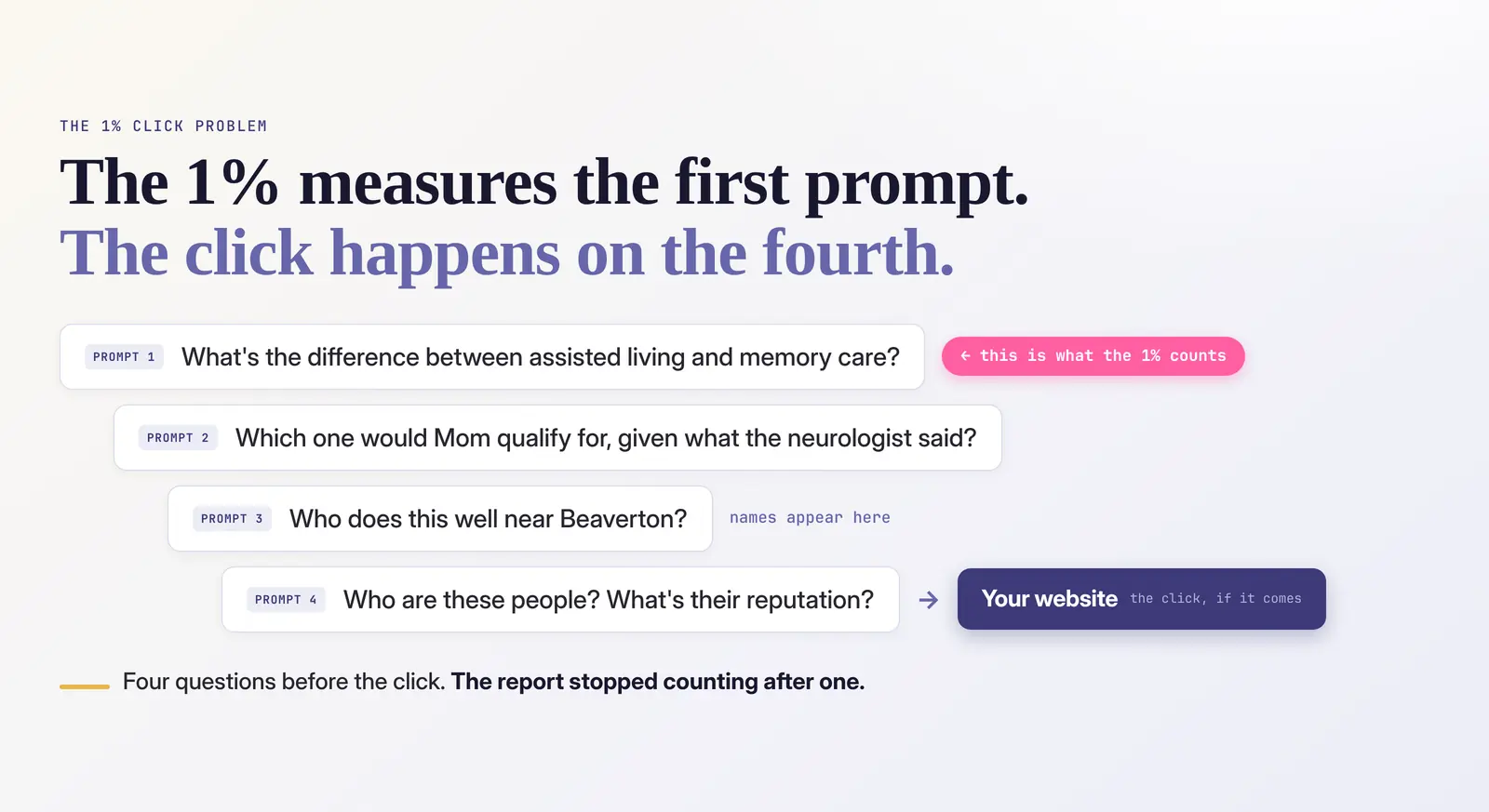
A daughter asks what the difference is between assisted living and memory care. She reads the answer. She asks which one her mother would qualify for given what the neurologist said. She reads that. She asks who does this well near Beaverton. Now she gets names. Then she asks about one of those names: who are these people, what do they actually do, what is their reputation.
That is four prompts, and the click, if it comes at all, comes at the bottom.
So you might have a 1% chance of winning the click on the first answer. Fine. But what is her next question off of that? The journey kept going. The report stopped counting.
Measuring the first prompt and calling it the funnel is like judging a tour by how many people picked up the brochure in the lobby.
The consumers did not go anywhere
Here is the part worth holding onto when the traffic graph looks grim.
There are not fewer families. Nobody's mother stopped needing care because the search interface changed. They are still going to pick a company. They are looking for an answer, or a solution to a problem sitting in their house right now.
Their path is just significantly different.
That distinction is everything. A collapsing market and a rerouted market look identical on a sessions chart and call for opposite responses. One says stop spending. The other says your spending is pointed at the old road.
We have watched this directly in our own accounts. One client lost 70% of its organic traffic over eighteen months and then had its best lead month on record. Another saw organic visits fall 31% year on year while leads fell only 12%, which means each visit got more valuable, not less. We wrote that up in full: traffic fell and leads went up.
What this does to content, and it is uncomfortable
If the click now arrives on prompt three or four, the job of your content changes.
You used to be competing for a position on a page. Now you are interrupting something. Somebody is reading an answer, or having one read aloud to them, and your job is to be the thing in that answer specific enough to make them stop and ask: who is this company?
Generic does not survive that. The "five signs your parent needs help" article is exactly what an assistant replaces, because the assistant can write it on demand and write it fine.
We have the receipt on this one. An elder law client came to us having published 141 articles produced the easy way, straight out of a model. We went through all of them. Between them they had brought in zero organic traffic. Not a little. Zero.
What we did instead was sit him down with a note taker and ask him to talk: tell us about that case, tell us why you do this differently, tell us about one you won that you should not have. Then we folded what he actually said into the articles. Same topics. Different substance. That is when they started working.
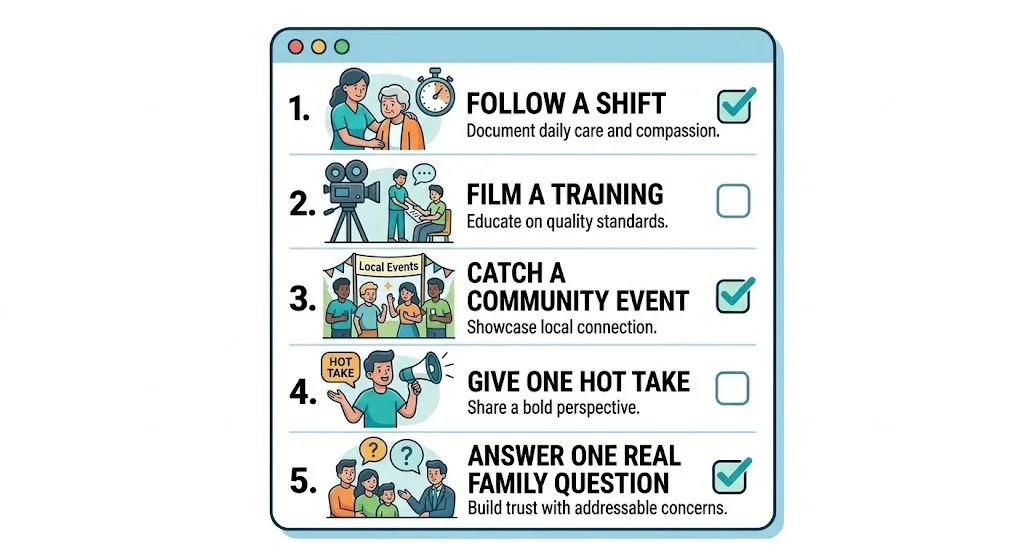
So what survives is the stuff an assistant cannot generate. The actual situation and what you did about it. Why you handle something differently from the firm down the road, and what it cost you to do it that way. A person on video saying a true thing. The specific, awkward, first-person material that most senior care marketing files under "we should do that sometime."
That used to be a nice-to-have. It was fractional, so nobody worried about it. It is not fractional now. It is the only kind of content that earns the fourth prompt.
And yes, that is hard to explain to a client, because "be the most useful source in your category" is a worse sales pitch than "we will get you to page one." It is also the accurate one.
What to count instead
The 1% figure is not a scorecard. Here is the shape of one that is.
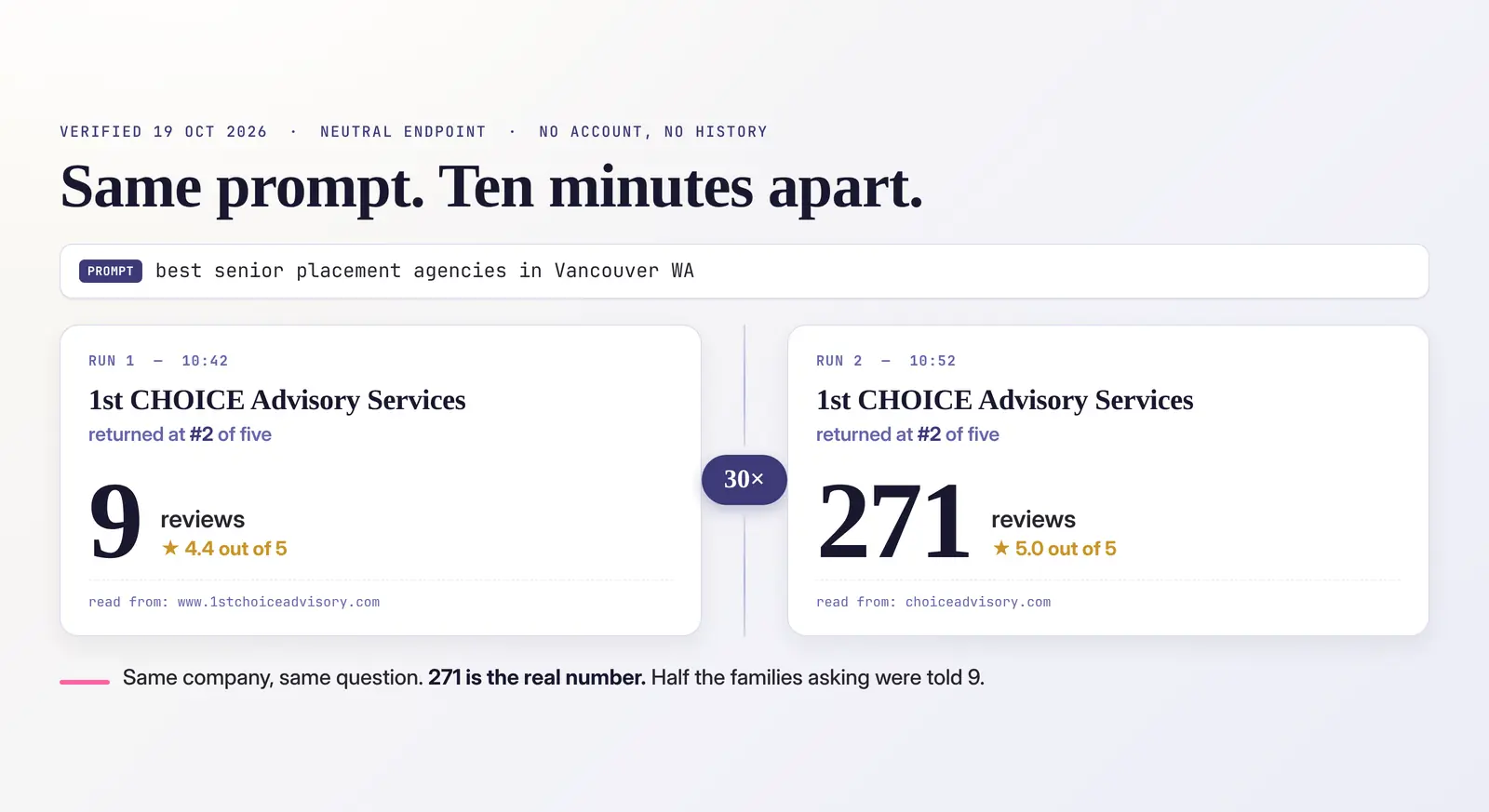
Mention rate, not rank. How often do you appear across the buying-intent questions a family would actually ask, measured over many runs rather than one? That is what AI mention rate tracks, and it moves slowly enough to be worth watching monthly. The "many runs" part is not a technicality. We recently ran one client's prompt twice through a neutral tool ten minutes apart and the same answer changed twice in ten minutes, on a basic fact about them. A single check cannot carry a decision.
Assistant-referred visits, and what they do. These show up in analytics as their own source now. The sample is small and that is fine, because what matters is the behaviour. In one client account, 7 visits came from AI assistants in a month and 2 of them became leads. Seven visits is not a study and I am not going to pretend it is. But it is the opposite direction from 1%, and it is the kind of number you can only get by looking rather than by forwarding somebody else's report.
Leads, by source, over twelve months. Not sessions. The October 13 piece makes this case in full and I am not going to re-argue it here.
Whether you are the source being quoted. If you are not cited anywhere in the answers your category produces, no amount of conversion-rate arithmetic is going to help, because you are not in the conversation to convert from. That is being the source an assistant quotes, and it is upstream of everything above.
Try this
Open an assistant and run the first question a family in your market would actually ask. Not your name. The question that comes before your name.
Then ask the follow-up. Then the one after that.
Count how many prompts it takes before a company like yours could plausibly get named, and notice which prompt it is.
That is where your content has to be. It is almost never the first one, which is exactly the one the 1% number is measuring.
Greatness Digital is a digital marketing agency in Oregon that works only with businesses that serve seniors: senior living communities, home care agencies, placement advisors, elder law firms, and senior move managers.
Not sure whether your traffic drop is a problem or just a different road? Let's look at the whole journey.
Frequently asked questions
- Is the 1% AI Overview conversion rate real?
- It is real as one company's observation and not real as an industry benchmark, and it is almost always quoted as the second. The figure traces to a single senior living operator, Heritage Communities, reported in trade press in January 2026, describing the rate at which people click out of an AI Overview to a sourced link on its site. There is no stated sample size, no measurement window and no independent counting. Before acting on it, ask what the denominator is, who measured it and over what period.
- Why is my website traffic down if there are still the same number of customers?
- Because the path changed, not the demand. People now get much of their early research answered inside the AI answer itself and arrive at your site later in the process, if at all. Fewer visits with the same or better lead volume is the normal shape of this, not a sign the market shrank.
- Where does the click actually happen in an AI search?
- Usually several prompts in. A typical senior care journey runs from a general question, to a qualifying question, to a local question, to a question about a specific provider. The visit to your website tends to come at the end of that sequence rather than off the first answer.
- What should senior care operators measure instead of clicks from AI?
- Mention rate across buying-intent prompts measured over many runs, visits referred by AI assistants and what those visitors do, and leads by source over a twelve-month window. Rank and single-session click data describe a search behaviour that is no longer the main one.
- Does this mean blog content is pointless now?
- No, but generic content is. One client had published 141 model-written articles that between them brought in zero organic traffic. Material an assistant can generate on demand no longer earns a visit. First-hand specifics, real situations, named trade-offs and video are what make somebody stop and ask who you are.