We almost sent a client a report telling them four months of SEO work had gone backwards.
It would have been wrong. Not slightly wrong. Wrong in the sense that the decline we were about to explain did not happen.
Here is the whole thing, including the part where we were confidently incorrect, because the lesson is more useful than the diagnosis.
What the report said
A senior living operator we work with, communities across two states. We are a few months into a technical SEO push.
Google Search Console showed impressions sliding. Top-three rankings had dropped. The month just closed looked like the worst in a while.
So we went looking for a cause, and we found one fast.
There were two versions of the same page in the data. One singular, one plural. Same content, same purpose. Both showing impressions, going back months.
That is a textbook problem. Two URLs competing for the same query, splitting authority, neither one winning. Keyword cannibalization.
It got better. The old singular URL was frequently sitting in position one or two. The live plural page was down at four, six, eight, twelve depending on the community.
So the story wrote itself. Google was still serving a dead page. The redirect was not being honored. Directory citations were feeding the old URL. Roughly 1,800 monthly clicks were being split across duplicate pairs.
Clean narrative. Clear villain. Obvious fix.
All of it was wrong.
The cross-check
Before writing any of that into a client report, we checked it against other sources. Not because we doubted it. Because that is the rule.
Four sources, independently:
- Ahrefs. The singular URL was not ranking anywhere.
- Live SERP data. We pulled the actual search results. The plural URL was there. The singular URL did not appear in the top 20 for anything.
- Google Analytics 4. The old URL had zero pageviews. Not a handful. Zero, across twelve months.
- The URL itself. We inspected it. Proper 301, redirecting correctly, and it had been doing so since 2021.
Every source disagreed with Search Console.
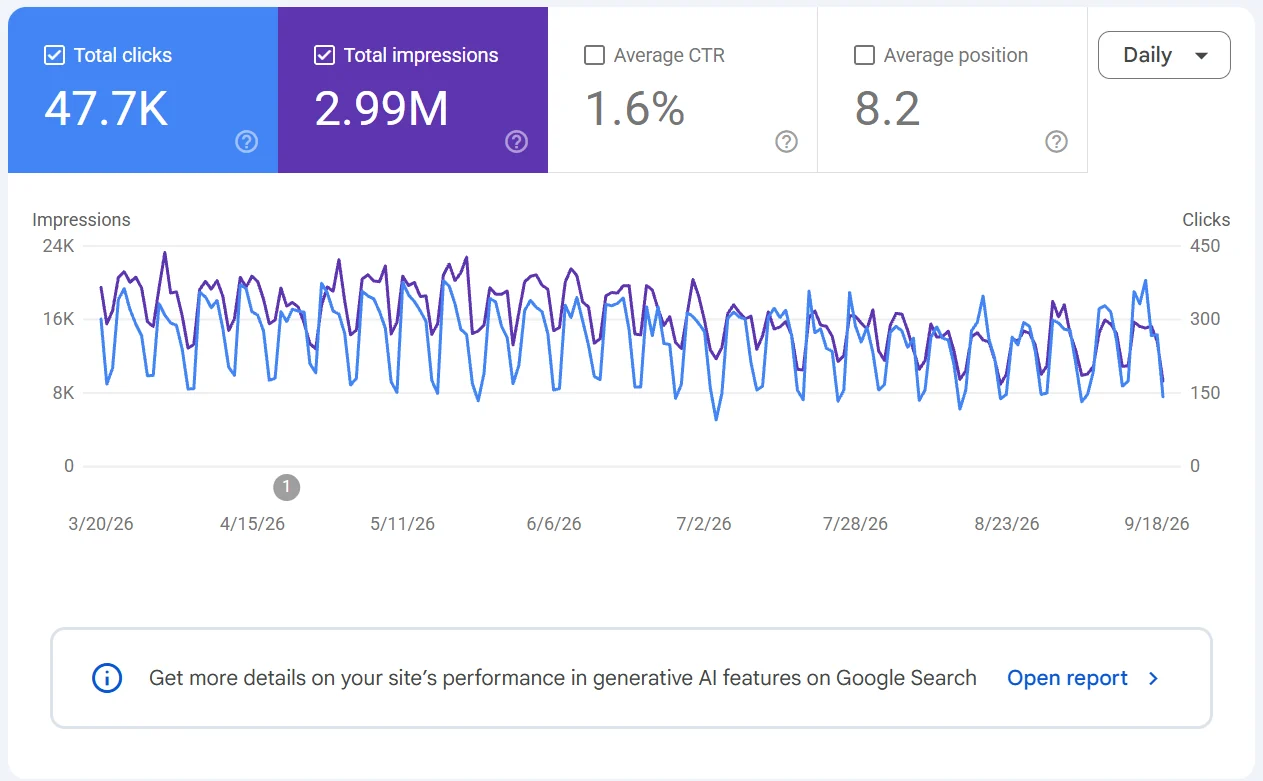
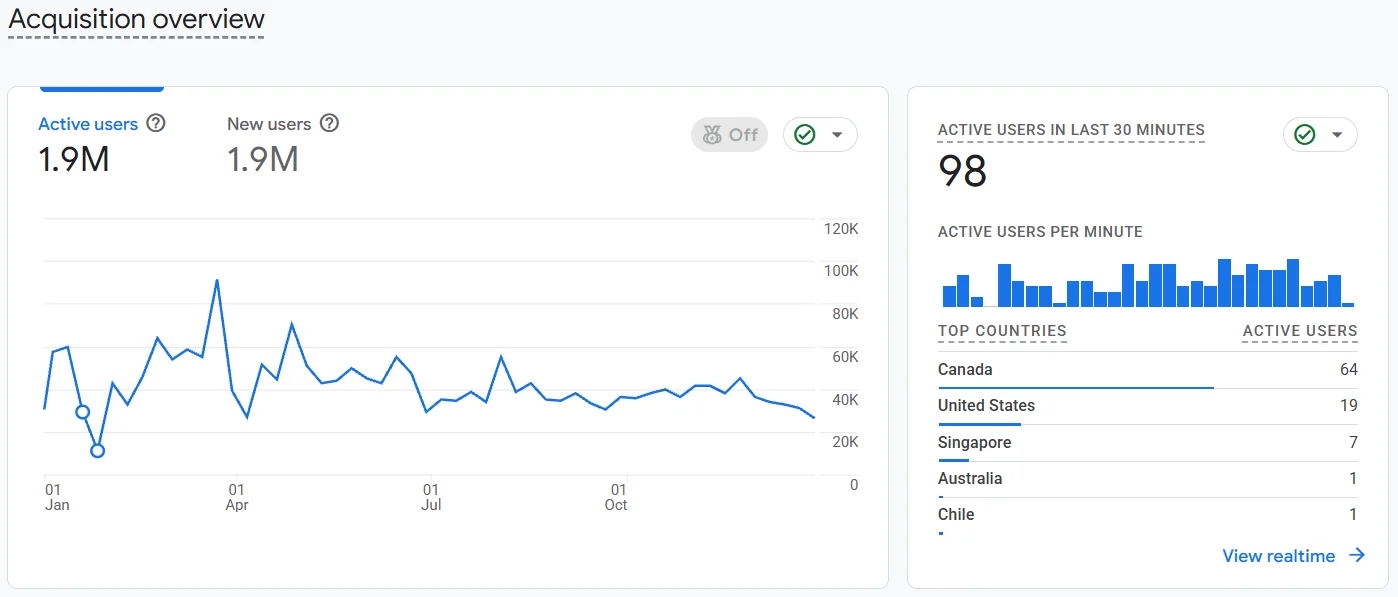
Search Console on the left, Analytics on the right. Two different systems measuring two different things: impressions and clicks from Google's side, against sessions that actually reached the site. A gap between them is normal. A URL carrying impressions with zero pageviews is not.
The redirect had never failed. Google was not serving a dead page. There was no cannibalization. Nothing was splitting 1,800 clicks, because the old URL was not receiving clicks at all.
Search Console was reporting against a legacy canonical record. It was showing us its internal bookkeeping, not what Google actually puts in front of a family searching for care.
I had been doing this a long time and had not seen it behave that way before.
So what was actually happening
Once the ghost data came out of the picture, the real numbers were unremarkable.
Organic traffic was essentially flat. Comparing the two most recent months, the difference was about six visitors. Not a decline. Noise.
And some of the work was clearly landing. One community's assisted living page had moved from an average position around 37 to about 1.4. That is page four to the top of page one.
The four months of decline was mostly an artifact sitting on top of a roughly flat baseline, with real wins underneath it that the report had buried.
If we had sent the original version, we would have spent a client call apologizing for progress.
The part that stings
We had not reached that first wrong conclusion by hand. We had run the analysis with AI assistance, and it produced a confident, coherent, well-structured root cause.
It was articulate. It was specific. It cited the right-looking evidence. And it was built on a data source that was lying.
That is the failure mode worth understanding, because it is not going away. AI analysis inherits the quality of its inputs and then presents the result with total composure. It does not hedge. It does not say "this one source disagrees with the other three," unless you make it look at the other three.
Garbage in, confident garbage out, formatted beautifully.
We use these tools constantly and they have made us much faster. But speed applied to an unverified input just gets you to the wrong answer sooner, with better formatting.
The verification step is not optional overhead. It is the actual job.
The real root cause
There is a satisfying ending to this.
We eventually worked out why the ghost URL kept generating impressions years after the redirect went in.
Every one of the client's Google Business Profiles still listed the old URL in its website field.
We were feeding it ourselves. Dozens of authoritative listings, pointing at a URL that had not been the real address since 2021, quietly keeping a legacy record alive in Google's index.
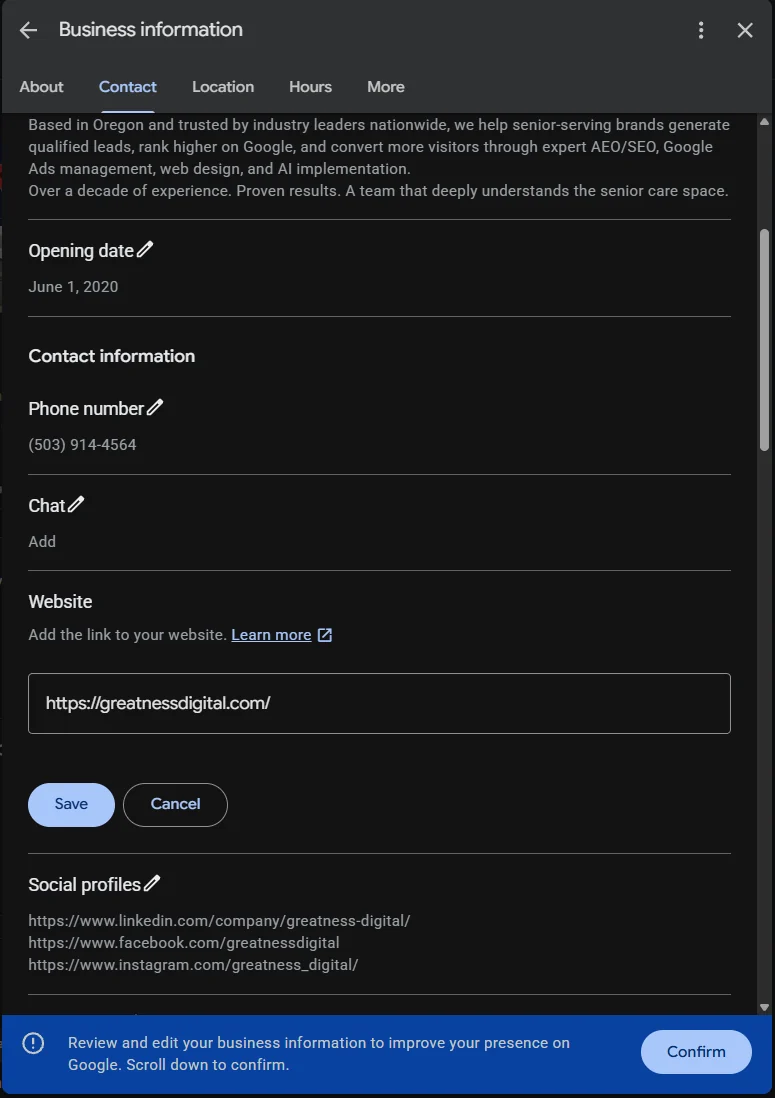
This is the field. Business information, Contact tab, Website. Ten seconds to check, and on most profiles nobody has looked at it since the day it was created.
We updated them on the call.
This is the genuinely useful, go-check-it-now part. Your Google Business Profile website field is one of the strongest signals you control, and it is the cheapest piece of local SEO there is. If it points somewhere stale, you are actively telling Google your old address is your real one, and you are muddying the entity picture that AI assistants use when a family asks who to trust.
If your site has been redesigned, migrated, or restructured in the last five years, go look. Every profile, every community, right now. It takes ten minutes.
The protocol
Here is what we do before anything goes in a report or a decision. It is the same discipline behind getting a business ready to use AI without getting burned by it.
- Never act on one source. Search Console, Analytics, a rank tracker, and a live SERP check. If they agree, the finding is real. If one disagrees with three, the outlier is usually the problem, not the finding.
- Check impressions against actual traffic. A URL with impressions and zero pageviews is not a ranking page. It is a bookkeeping entry.
- Verify the mechanism, not just the symptom. Before concluding a redirect is broken, inspect it. Before concluding a page is cannibalizing, look at the live results.
- Ask what timeframe you are comparing. Comparing a period contaminated by ghost impressions to a clean one produces a decline that never happened.
- Make AI show its disagreements. Ask what data would contradict the conclusion. Ask which sources were not checked. A tool that cannot tell you where its analysis is weak is not finished analyzing.
What to do with your own report
If your agency hands you an SEO report showing a drop, three questions.
Which independent sources confirm this, and do they agree?
Does the traffic data in Analytics match the impression data in Search Console?
What is the specific mechanism, and has anyone verified it rather than inferred it?
A good partner will have answers ready, and will occasionally tell you the scary number was an artifact. That is not spin. Knowing what your data actually says, including when it says nothing, is the part you are paying for.
The same instinct applies to the content you already have. Before you commission anything new, audit what you already published, because the wins are often sitting in pages you have already paid for.
We came very close to selling a client a crisis that did not exist. The only reason we did not is that we checked.
We work only with businesses that serve seniors: senior living communities, home care and home health agencies, senior placement advisors, elder law firms, and senior move managers. If you serve seniors, we serve you.
Want a second set of eyes on a report that does not sit right? Let's talk.
Frequently asked questions
- Why does Google Search Console show impressions for an old URL that redirects?
- Search Console can report against a legacy canonical record rather than the URL Google actually serves. The old URL can appear with impressions and even strong average positions while receiving zero real traffic. Confirm by checking Google Analytics for pageviews on that URL and by running a live search to see which version actually appears. If Analytics shows nothing and the old URL is not in the live results, you are looking at a reporting artifact, not a ranking problem.
- Why don't Google Search Console and Google Analytics numbers match?
- They measure different things. Search Console reports impressions and clicks from Google's side, including under canonical records that may be outdated. Analytics reports sessions that actually reached your site. Some difference is normal. A URL with substantial impressions and zero pageviews is the signal that something is wrong with the reporting, not the site.
- Can an old URL hurt my SEO after a 301 redirect?
- A correctly configured 301 passes authority and is generally not a problem. The more common issue is external sources still pointing at the old URL, especially your Google Business Profile website field, directory listings, and citations. Those keep the legacy record alive in Google's index and muddy how search engines and AI assistants understand your business as an entity.
- How do I know if my senior living SEO report is accurate?
- Ask which independent sources confirm each finding. A trustworthy report cross-references Search Console, Analytics, a rank tracker, and live search results, and states the specific verified mechanism behind any change rather than an inferred one. If a decline appears in only one source, ask why before acting on it.
- Should I trust AI-generated SEO analysis?
- Use it, and verify it. AI analysis is fast and thorough, and it inherits any error in its source data while presenting the result with complete confidence. It will not flag that one input contradicts three others unless you ask it to check. Treat AI output as a strong first draft that still requires verification against primary sources.