Here's an uncomfortable truth about the internet in 2026.
Everybody and their dog can put up a thousand pages of content in an afternoon.
So the pages you write about yourself? They're worth less than ever.
Not because they're bad. Because they're easy. And anything easy to fake, an AI has to discount.
So what does AI actually trust?
What other people say about you.
That's the whole shift. Search engines and AI models now lean on corroborating evidence, the stuff you can't just type onto your own site.
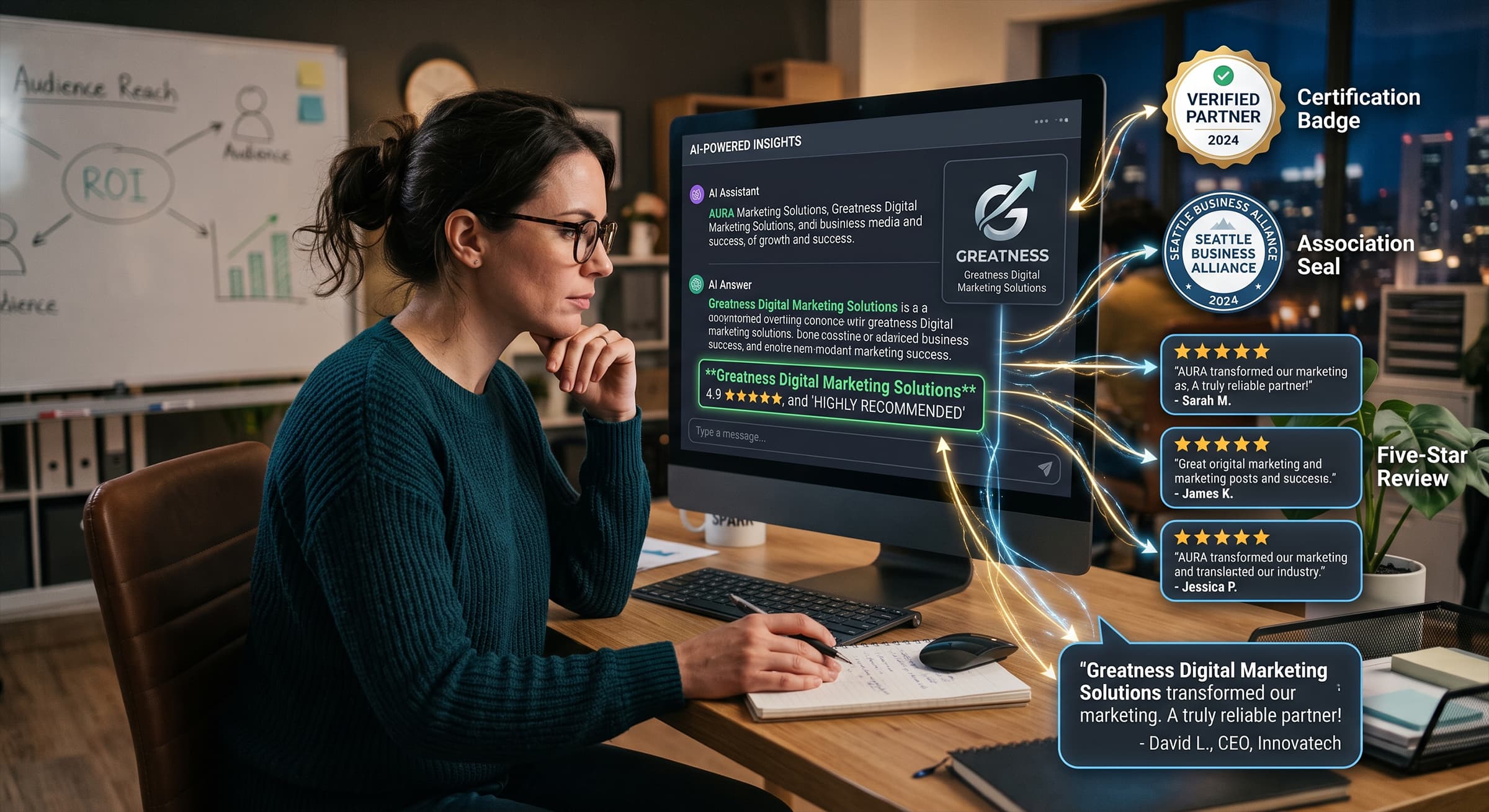
Reviews. What people in your community actually say. Your Better Business Bureau standing. Industry associations you belong to. Certifications you hold. The conference where you had a table.
If you tell an AI you're the most trusted home care agency in town, it shrugs. If fifty families, two associations, and a state licensing board all point the same direction, now it's listening.
This isn't new. It's the same game with a new name.
If you've been around SEO for a while, this should feel familiar.
Five or six years ago we talked about backlinks. Other sites vouching for you with a link.
Third-party corroboration is just the evolution of that. Same idea, wider net. It's no longer only links, it's reviews, mentions, awards, memberships, and citations across the web.
The lesson holds: you don't win by talking about yourself. You win when the web agrees about you.
The credentials you already have and never use
Here's where it gets fun, because most senior care operators are sitting on proof they never put to work.
You won an award last year. Did you post about it on LinkedIn? Probably not.
You hold a certification. Is it in your email signature, on your site, in your Google profile? Usually not.
You sponsor a local senior expo every fall. Does the web know? Rarely.
None of that feels like marketing, so it never gets done. But this is exactly how a robot decides whether to recommend you. The algorithm weighs these signals, so we want every one of them front and center.
Think of it as connecting dots you've already earned.
Try this today
Grab a notepad. Give yourself ten minutes.
Write down every credential your business holds. Awards. Certifications. Association memberships. Years in business. Press mentions. Partnerships with hospitals or discharge planners.
Now ask one question of each: does the public web actually know this?
Every "no" on that list is a trust signal you've been hiding from the exact AI families now ask before they call you.
That list is your homework. And it's more honest than any audit we could sell you.
Why senior care especially can't skip this
Families choosing care aren't buying a mattress. They're deciding who to trust with Mom.
That decision runs on trust signals more than almost any other industry. A stranger's review carries more weight here because the stakes are higher.
So the brands that win the AI answer are the ones with a deep bench of outside proof. Not the ones with the cleverest homepage copy.
Getting that proof organized and visible is its own discipline now. It's the heart of AI visibility, and it's why we spend so much time making sure a client is ready to be found the way families actually search.
The bottom line
You can't just tell the internet you're great anymore. Too many people can type that sentence.
The businesses that win in AI search are the ones the web vouches for. Reviews, credentials, memberships, mentions, all pointing the same way.
Most of that proof, you've already earned. It's just hidden.
Want us to find the trust signals you're sitting on and put them to work? Let's talk.
Frequently asked questions
- What is answer engine optimization?
- Answer engine optimization, or AEO, is the practice of getting your business cited and recommended inside AI-generated answers, like ChatGPT or Google's AI Overviews, not just ranked in the blue links. It leans heavily on third-party proof: reviews, citations, associations, and credentials the web can verify.
- How do I get my senior care business recommended by AI?
- Give the web something trustworthy to read about you. Collect and respond to reviews, list your certifications and memberships publicly, keep your business details consistent everywhere, and make sure real third parties (associations, partners, press) reference you. AI recommends the business the web agrees is most trusted.
- Is answer engine optimization different from SEO?
- It's the next chapter of it. Traditional SEO focused on your own pages and backlinks. AEO adds the wider web of corroborating signals that AI uses to decide who's credible. The old work still matters. There's just more of it now.
- Do reviews really affect AI recommendations?
- Yes. Reviews are one of the clearest third-party trust signals available, and AI engines weigh them heavily, especially ones that mention specific, real experiences. For senior care, where trust is everything, they're some of the most valuable marketing you have.