I run a marketing agency that records almost everything.
Every client call has an AI note taker in it. Discovery calls, brand voice interviews, strategy reviews, our own Monday meetings. Those recordings become brand guides, article drafts, and the answers to questions nobody wrote down at the time. I would struggle to do this job without them now.
So I was not expecting to be the person in the room who felt uncomfortable.
What happened
I was at a networking meeting. Not a conference, not a webinar. The handshake kind. Name tags, coffee, breakout groups.
Our group was given three questions to work through. What are the biggest challenges seniors face today, and how do you solve them.
Good questions for that room. Most of us there work with older adults in one way or another.
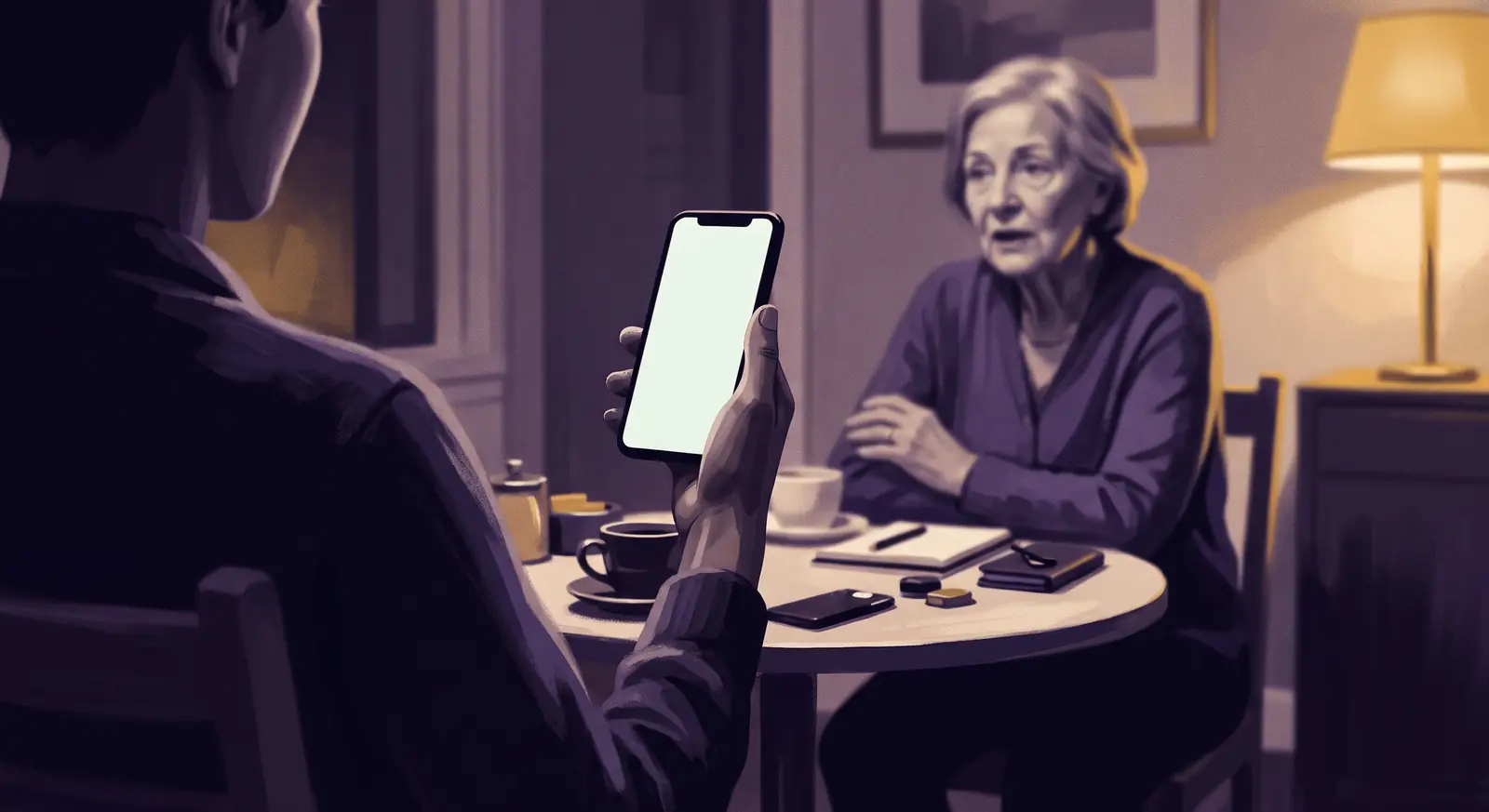
Then one person in the group took out her phone, opened an AI note taker, and held it up to each person's face as they answered. Like an interview. Right in front of them.
She did not ask. I do not think it occurred to her to ask. The room was loud and she wanted clean audio, and from where she was standing that was the whole of it.
One woman in our group had started answering in her own normal way. Then the phone came up.
She went, oh. Oh.
And then she said something different from what she had been about to say.
I have thought about that moment more than I expected to.
Why it bothered me, when I use this every day
Here is what nagged at me. I am not a sceptic about this technology. I use it constantly. I have argued for it with clients who were nervous about it.
But in that room it felt like we had put technology into a place that was supposed to be human, and I wanted to protect that place.
I could not tell whether that instinct was right, or whether I was just unused to seeing it off a screen.
So I asked Eric and Daniel.
Eric: for networking specifically, it is too much
Eric's first point was about what networking is actually for.
A lot of ideas get thrown around in a room like that, and people float things they are not ready to have written down. Not everything has to be recorded.
He spent years in banking, where people would get defensive about somebody taking notes on paper during a conversation. Why are you writing things down about me. That reaction is older than AI.
His view: in a clear business setting, a note taker is normal now and people expect it. Outside one, ask. Even something light. It is loud in here, I would like everyone to be able to keep their notes, how does everyone feel about that.
Then he made the point I had not reached on my own. When a mic is in your face, you may not say what you actually mean, because you are busy calculating how it could be used later. And the entire point of the room is to be open.
Daniel: there is a legal line, and a social one
Daniel went straight to the part I had not thought about at all.
Oregon and Washington are both two party consent states. Both sides have to agree to being recorded. And an AI note taker is recording somebody, whatever we choose to call it.
Then he made the sharper point.
Networking always has somebody breaking the social rules. The person doing it walks away with the notes they wanted and not much else. No relationships. No likeability. They optimised for the wrong thing.
That reframed it for me. The recording was not just uncomfortable. It cost her the thing she came for.
The line I could not find
I pushed on this, because I genuinely did not know where the boundary sits.
You can be recorded in public. Somebody can stand on a sidewalk and film you. There are cameras in the ceiling of nearly every building we walk into, including plenty of senior living communities.
So why does a phone on a table feel different from a camera on a wall.
Eric's answer was the cleanest thing anybody said all hour.
Most of those cameras do not record audio. They record video. You understand you are on camera, but your voice is not being captured. And when you can see somebody doing it, pointed at you, it puts you somewhere else entirely.
That is the line. Not public versus private. Passive versus pointed, and whether your words are being kept.
Daniel's resolution, which is the actual answer
Daniel's last point is the one I have taken into my own work.
He said the thing you explain is not the note taker. It is the reason for the call.
When he starts a brand voice interview, he does not announce the recorder and move on. He says what the conversation is for. We are going to ask some questions, we are building a brand voice document, we are recording because we want to represent your company accurately, and the reason we ask about a specific family you helped is that we can draw on it later.
Once somebody understands why you are asking, the recorder stops being the subject.
The discomfort in that networking room was never really about technology. It was that nobody in the group knew what the recording was for.
Why this matters more if you serve seniors
I think this matters more in our industry than in most.
The people we work with sit with families on the worst days those families have had. A daughter calling about her father after a stroke is not a lead. The conversation she is about to have is not a data capture opportunity.
Some of our clients have started using AI note takers internally, and that is usually a good thing. But there is a difference between recording your own team meeting and holding a phone up to a family in a living room.
If you are going to use one in front of a family, say why first. Not because the law requires it, although in Oregon and Washington it does. Because the moment somebody realises they are being recorded without knowing the purpose, you have lost the part of the conversation you actually needed.
Where I landed
Daniel thinks this is temporary. He pointed out that recorders in Zoom meetings were weird too, and now nobody blinks. He is probably right that the in-person version normalises as well.
I still think it is too early, and I no longer think the asking is a formality. It is the thing that makes the difference.
I record nearly every client conversation I have, and I will keep doing it. I will also keep saying what it is for at the start. It turns out I was already doing that. Now I know why it matters.
Greatness Digital is a digital marketing agency in Oregon that works only with businesses that serve seniors: senior living communities, home care agencies, placement advisors, elder law firms, and senior move managers.
Thinking about where AI fits in a business built on trust? Let's talk.
Frequently asked questions
- Is it legal to use an AI note taker in a meeting?
- It depends where you are. Oregon and Washington are both two party consent states, which means everyone being recorded has to agree. An AI note taker is recording, whatever it is called. In a clear business setting most people now expect one and consent is easy to get. Outside one, ask before you start.
- Do I need to announce an AI note taker on a client call?
- Yes, and explain the purpose rather than just the tool. Saying what the conversation is for, and what the recording will be used for, works far better than announcing a recorder and moving on. Once somebody understands why you are asking, the recorder stops being the subject.
- Why does an AI note taker feel different from a security camera?
- Most cameras record video, not audio, and they are passive. A phone pointed at your face is capturing your words and you can see it happening. The useful line is not public versus private, it is passive versus pointed, and whether what you say is being kept.
- Should senior care providers use AI note takers with families?
- Internally, for team meetings and training, they are genuinely useful. In front of a family in crisis, be careful. Say what it is for before you start, or do not use it. The moment a family realises they are being recorded without knowing why, you lose the openness the conversation depends on.