

In this article
Everybody in marketing gives the same advice when results are good. Spend more.
It is the easiest recommendation in the business. It is sometimes right. And this quarter we watched it fail and its opposite succeed, in two accounts, at the same time.
Account one: more money, worse return
Managed Moves, a Portland senior move management client of ours, had been running Google Ads at roughly $1,200 a month with a return on ad spend averaging around 4.5x. Genuinely good numbers in a category where a single job is worth real money.
We made a reasonable decision. They had a second campaign running on estate clean-outs that was underperforming, so we paused it and pushed the whole budget behind moving, which was the winner. Spend went to about $1,900 a month.
Return fell to 2.4x.
Not a small dip. Close to half, on a 58 percent increase in spend, with the budget concentrated on the best performing campaign we had.
The first assumption everybody makes, us included, is lead quality. More spend means the algorithm reaches further down the barrel, pulls in people who were never going to buy, and the sales team wastes its time.
So Eric went and audited the missed calls, one at a time, to find the bad leads.
There were not any.
The calls that had gone unanswered were job seekers, wrong numbers, and people who were not customers in any sense. Not a single missed opportunity hiding in there. Lead quality had not collapsed. The extra money had simply bought less.
Account two: less money, better leads
At almost the same time we were going the other direction with a contractor client.
His September leads were poor. Spam submissions, enquiries for jobs far too small to be worth quoting, the usual. The target budget for the account had been somewhere between $2,000 and $3,000 a month.
We cut it to about $900.
Not as a punishment and not to save money. The logic is that modern ad platforms optimise toward whatever you feed them, and if you are feeding them a wide budget and a loose definition of success, they will find you volume. Narrowing the budget forces the algorithm to be selective and gives it a cleaner signal about what a good outcome actually looks like.
Six conversions in October, of noticeably better quality. The plan now is to walk the budget back up gradually, watching whether quality holds at each step.
We run accounts like these through our Google Ads management service.
So which one is the lesson?
Neither on its own, which is why I wanted to publish them together.
If I only told you the first story, the lesson would be "do not scale." If I only told you the second, it would be "cut your spend." Both are wrong as general advice and both would be quoted as if they were laws.
The actual lesson is narrower and more useful.
A local market has a floor of real demand and you can hit the bottom of it. There are only so many people in a metro area who need a senior move manager this month. Once your ads have reached all of them, the next dollar buys someone who is less likely to convert, almost by definition. Return falls, not because anything broke, but because you ran out of the good stuff.
And the algorithm optimises toward whatever is easiest to produce. If your budget is generous and your conversion definition is loose, it will deliver the cheapest conversions available rather than the most valuable. Constraint is a form of instruction.
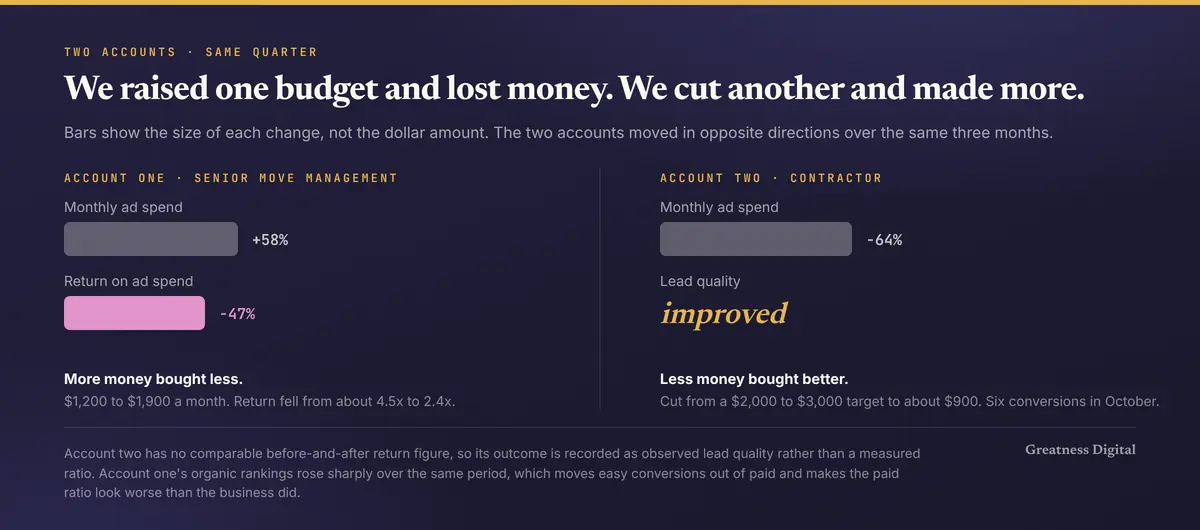
Those two forces point in opposite directions, which is why one account improved by going up and then down, and the other by going down and then up.
The part that gets left out of scaling conversations
Something else happened in that first account that complicates the story, and leaving it out would make this article neater and less true.
While paid return was falling, the organic side was climbing hard. Average keyword position improved from 26 to 16.5 across the tracked set. The single most valuable term in their category moved up 31 places to position 6.
So the business was getting more visible and cheaper to reach at exactly the moment the paid ratio looked worse.
If you judge that quarter on return on ad spend alone, you conclude the marketing got worse. If you look at the whole picture, the opposite happened. Organic growth can make your paid numbers look bad, because the easiest customers start arriving for free and the ads are left with the harder ones.
Almost nobody accounts for that, and it is a real reason to be careful about judging channels in isolation.
How to tell which problem you have
If your return fell after you increased spend, work through these in order.
Audit the leads you think you lost. Not the ones that converted. The missed calls and the unanswered forms. We found zero real opportunities in a pile that everybody assumed was full of them. Until you check, you are guessing.
Check what your organic traffic did over the same period. If it rose meaningfully, some of your easiest conversions moved channels and your paid campaigns are now working harder for the same outcome.
Look at impression share. If you were already showing for nearly every relevant search before the increase, the extra budget had nowhere good to go and went somewhere worse.
Check what you are telling the platform to optimise for. If every conversion in the account has the same value, the algorithm is chasing the cheapest one. That is usually a general enquiry rather than a booked job.
If all four come back clean and return still fell, you have probably found the ceiling of your market, and the answer is a different channel or a wider service area rather than more money in the same place.
You can read our pricing before we ever talk.
What we tell clients now
When an account is performing, the honest answer to "should we spend more" is: we can try it, we will know within about a month, and we may well come back and recommend putting it back.
That is a less satisfying thing to say than yes. It is also the only version that survives contact with two accounts moving in opposite directions in the same quarter.
Budget is not a dial where more input produces proportionally more output. It is closer to a tap filling a container of a fixed size, and the size of that container is set by your market, not by your ambition.
Greatness Digital is a digital marketing agency in Oregon that works only with businesses that serve seniors: senior living communities, home care agencies, placement advisors, elder law firms, and senior move managers.
Want somebody to work out whether your account has room to scale? Let's talk.
Frequently asked questions
- Why did my return on ad spend drop when I increased my budget?
- Most often because you reached the limit of real demand in your market. Once your ads have been seen by everyone actively looking, the next dollar reaches people less likely to convert. Check your impression share before the increase: if it was already high, there was nowhere better for the money to go.
- Can cutting my ad budget improve lead quality?
- Sometimes, yes. Ad platforms optimise toward whatever is cheapest to produce within the budget you give them. A tighter budget forces selectivity and gives the algorithm a cleaner signal. We cut one account by roughly two thirds and lead quality improved immediately.
- Is there a maximum ad budget for a local business?
- Effectively yes, set by how many people in your area actually need your service this month. It varies by category and season. The signal that you have reached it is that impression share is already high and additional spend produces weaker leads rather than more of the same.
- How do I know if my leads really got worse?
- Audit them individually, including the ones you missed. We went through a full set of missed calls expecting to find lost opportunities and found none: they were job seekers and wrong numbers. Assumptions about lead quality are usually wrong in one direction or the other.
- Can good SEO make my paid ads look worse?
- Yes, and it is commonly misread. As organic visibility improves, the easiest customers start arriving without clicking an ad, leaving your paid campaigns to work on the harder ones. Return on ad spend falls while the business as a whole improves.